Short answer: Information architecture (IA) is the practice of structuring, labelling, and organising content so users can find what they need and complete tasks easily. Strong IA reduces cognitive load, improves SEO via clear hierarchy, and is usually the cheapest UX investment with the largest payoff. (Further reading: NN/g — information architecture study guide.)
📅 Last updated: June 6, 2026
⏱ 6 min read · 1,305 words
Related reading: see the core principles of UX design and typography in UI design. Want help applying this to your product? Explore our UI/UX design services.
Every day, businesses invest heavily in UI/UX design because modern users expect fast, organized, and intuitive digital experiences. However, many companies make the mistake of focusing entirely on visual aesthetics first. Even the most visually impressive, best-looking interface can completely fail if users cannot find information quickly or navigate smoothly.
Think of your website like a physical building. No matter how beautiful the interior Web design is, if visitors cannot find the entrance, the stairs, or the restrooms, they will leave out of sheer frustration. In the digital world, that frustration leads to high bounce rates and lost revenue.
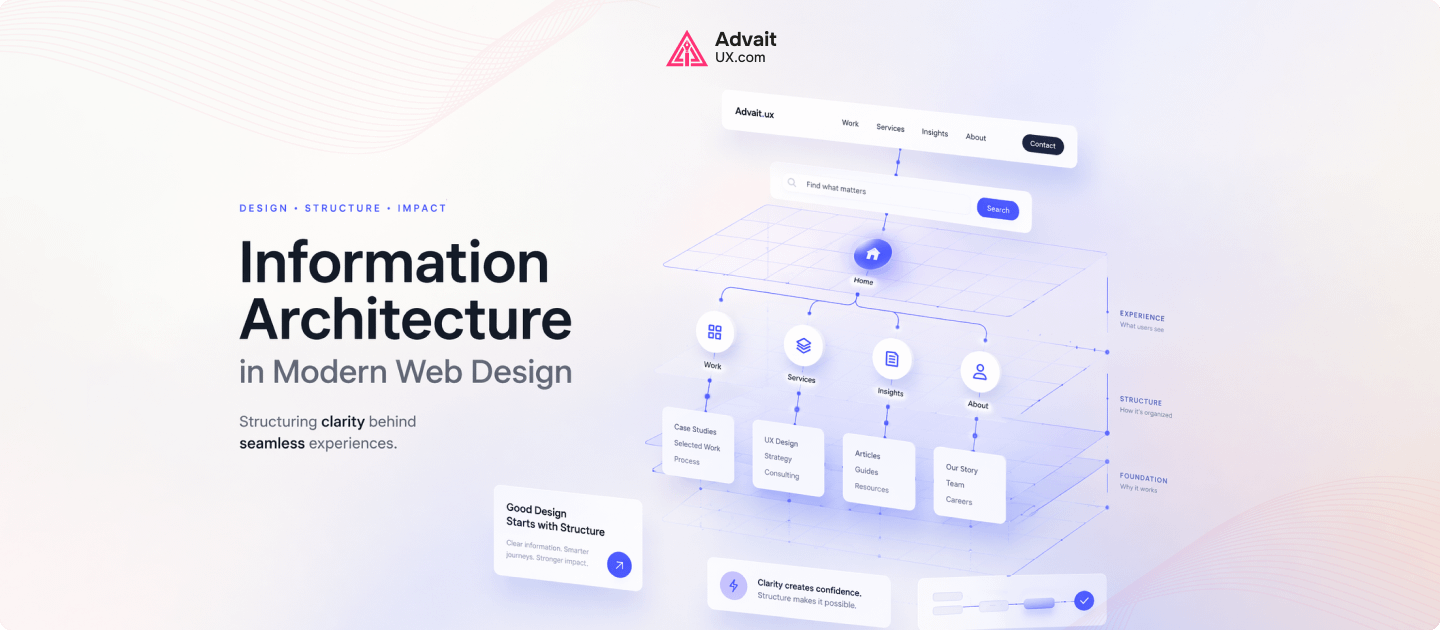
A strong information architecture (IA) serves as the hidden skeleton of your Modern Web Design. It helps users understand exactly where they are, what actions they can take next, and how to complete their goals without a shred of confusion. If you want to improve your digital product strategy and build a highly intuitive platform, you can explore the UI UX Design Services.
What Is Information Architecture?
Information architecture, commonly referred to as IA, is the strategic process of organizing, structuring, and labelling content in a way that makes navigation simple and intuitive.
Instead of dumping content onto a page and hoping users find what they need, IA focuses heavily on:
Content Hierarchy: Ordering information by its level of importance.
Navigation Structure: Creating predictable pathways for users to browse.
User Flows: Mapping out the exact steps a user takes to complete a specific task.
Page Relationships: Understanding how different pages and content blocks connect to one another.
Search and Discoverability: Making it effortless for users to locate specific data points.
Ultimately, a well-structured UI/UX design website guides users naturally through the digital experience, helping them find the right information with minimal cognitive effort. For a deeper dive into the fundamental psychology behind this structure, explore the Nielsen Norman Group’s IA Guide.
Why Information Architecture Matters in Modern Web Design
Modern digital Web Design users make decisions in a matter of seconds. If a website feels cluttered, confusing, or disorganized, they will abandon it immediately to visit a competitor.
Without a proper foundation, even the most advanced UI/UX design services will struggle to deliver a truly impactful user experience. When you intentionally Web design your IA, you see massive improvements across several critical business metrics:
Website Usability: Reduces friction, making the site highly functional for all visitors.
User Engagement: Keeps users browsing longer because finding relevant content is seamless.
Navigation Clarity: Eliminates guessing games so users always know their way around.
Conversion Rates: Guides users directly into your sales or signup funnels smoothly.
SEO Performance: Helps search engine bots crawl and index your site effectively.
To see how strategic UX directly impacts your business performance, check out AdvaitUX.
The 4 Key Components of Effective IA
To build a Modern Web Design that performs, professional UI/UX design companies rely on four fundamental pillars of information architecture:
1. Content Hierarchy
Content hierarchy organizes information based on its priority and importance. A standard, highly effective hierarchy ensures that primary navigation displays top-level pages for immediate access, secondary sections support deeper exploration, and crucial calls-to-action (CTAs) remain highly visible at all times.
2. Navigation Systems
Navigation is the most visible and interactive extension of your information architecture. An effective navigation system requires:
Simple, uncluttered menus
Logical, predictable categories
Clear, descriptive labels
Consistent placement across every single webpage
3. User Flows
User flows map out the behavioral journey a visitor takes to successfully finish a task. Common examples include:
Purchasing a product from an e-commerce store
Booking a specific corporate service
Completing a signup/onboarding process
Web Designing strong user flows drastically reduces user friction and boosts conversions.
4. Labeling and Content Organization
Labels should always be simple, familiar, and highly recognizable. While creativity is great for branding, complex terminology or overly clever phrases in your menu options usually confuse users. Modern Web design always prioritizes absolute clarity over creativity when it comes to navigation labels.
For more context on how these frameworks are structured, read the literature by the Interaction Design Foundation.
Information Architecture vs. UI Design: What’s the Difference?
It is common for businesses to confuse information architecture with User Interface Modern Web Design, but they serve completely distinct purposes in the development cycle.
A successful UI/UX design company seamlessly combines both disciplines to create digital experiences that are both beautiful to look at and effortless to use.
How Information Architecture Affects Your SEO
Information architecture doesn’t just impact human visitors — it also directly influences how search engines view your website. Google heavily prefers websites that feature a clear structure, organized content, logical internal linking, and easy navigation.
When your Modern Web Design website is well-planned, it vastly improves crawlability, allowing search engine bots to index your pages accurately and reward you with better visibility. Read Google’s official explanation on website structure in the Google SEO Starter Guide.
Common IA Mistakes to Avoid
When audit testing platforms, usability issues almost always stem from poor structural architecture rather than poor visual layout. Watch out for these common mistakes:
Overcomplicated Navigation: Giving users too many menu options, leading to choice paralysis.
Poor Content Grouping: Placing pages or products under irrelevant or confusing categories.
Inconsistent Labels: Changing menu terminology from page to page.
Ignoring the Mobile Experience: Forgetting that IA must effortlessly support responsive navigation and touch-friendly interactions across all screen sizes.
How AdvaitUX Builds Data-Driven Architecture
At AdvaitUX, we believe that information architecture decisions should always be rooted in real user behaviour, not creative assumptions. Professional UI/UX design services utilize thorough research and behavioural testing to map out the perfect content structure.
To build clear and scalable digital experiences, our team utilizes proven research methodologies:
User Interviews & Card Sorting: Discovering exactly how your target audience naturally categorizes information.
Tree Testing: Evaluating whether users can find a specific item within a text-only menu structure before visuals are even applied.
Heatmaps & Analytics: Tracking where users click, look, and drop off on your current live site.
Usability Testing: Gathering real-time feedback to solve navigational friction before development costs scale up.
In many of our website redesign projects, we find that simply restructuring web design product categories and simplifying navigation improves conversions far more than changing background colours or button layouts.
Partner With a Trusted UI/UX Design Company
Thoughtful information architecture web designed today creates highly successful, stress-free user experiences tomorrow. Investing in a strong structural foundation allows businesses to experience:
Stronger digital engagement
Frictionless customer journeys
Higher long-term growth
Whether you are mapping out a brand-new digital platform or planning a massive redesign of an existing website, AdvaitUX can help you craft intuitive, clear, and scalable digital solutions.
💡 Working on your own product? Start with a structured UX audit to surface the highest-impact friction in 1–3 weeks, or get in touch to scope a project with our Austin-based team. You can also see our recent UI/UX projects for examples.
Frequently Asked Questions
What is information architecture in web design?
Information architecture (IA) is the practice of organizing, structuring, and labeling content so users can find what they need and complete tasks easily. Good IA reduces cognitive load and is the backbone of any usable website.
Why is information architecture important?
Poor IA causes users to abandon sites and increases support load. Strong IA improves SEO (clear hierarchy), accessibility, conversion, and discoverability — it’s usually the cheapest UX investment with the biggest payoff.
About the Author
Darshan Italiya is the Founder & UX Lead at AdvaitUX, a UI/UX design agency based in Austin, TX. A Google-certified UI designer with 7+ years of experience and 70+ shipped product designs, he writes about user-centered design, UX strategy, and conversion-focused interfaces. Learn more about AdvaitUX or connect on LinkedIn.