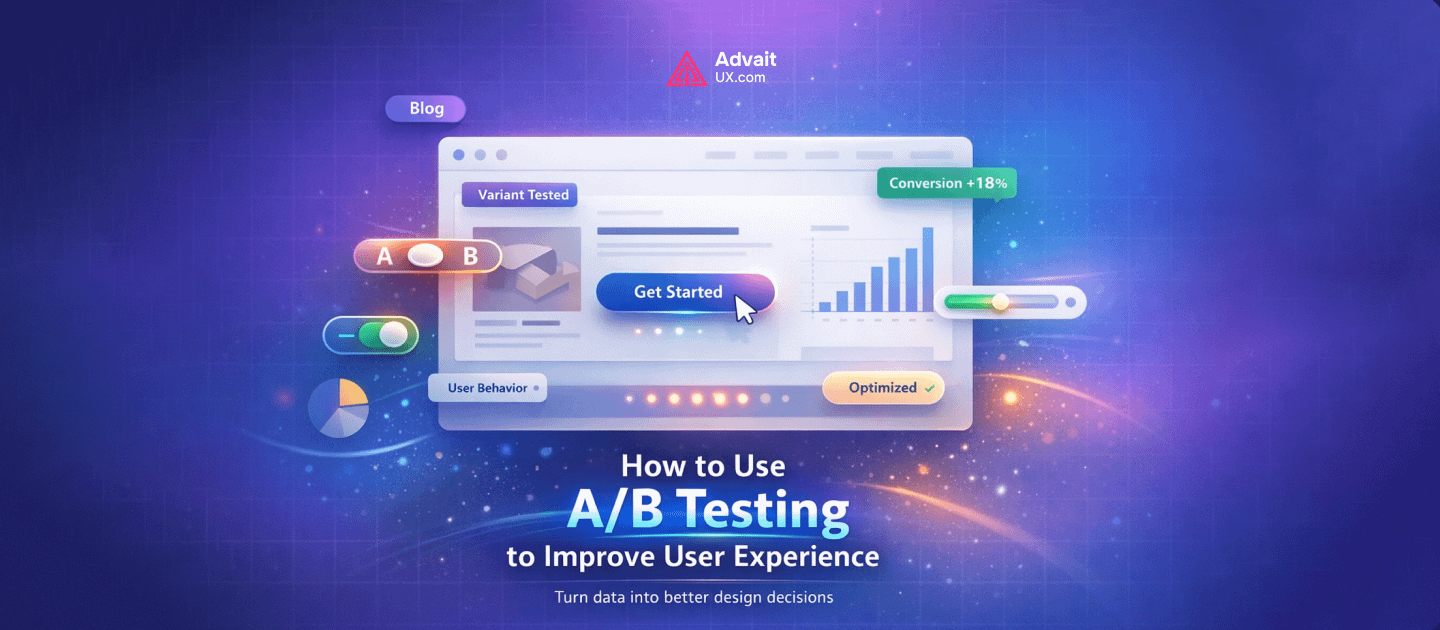
Short answer: A/B testing in UX is comparing two versions of a screen, flow, or element with real users to see which performs better on a measurable goal — conversion, completion, or time-on-task. Run it when you have meaningful traffic, a clear hypothesis, and a single variable to test; skip it for cosmetic-only tweaks. (Further reading: NN/g — how to do A/B testing in UX.)
📅 Last updated: June 6, 2026
⏱ 8 min read · 1,737 words
Related reading: see how good UX increases revenue and why users leave a website. Want help applying this to your product? Explore our UI/UX design services.
In the technology industry, great products are rarely built on assumptions. The most successful digital platforms, SaaS applications, and enterprise solutions are shaped by a deep understanding of user behavior. While product teams often have strong opinions about design and functionality, real users frequently interact with products in ways that teams never anticipated.
This is why A/B testing has become a fundamental practice for organizations focused on delivering exceptional user experiences. Rather than relying on intuition, A/B testing enables businesses to validate decisions through data and real-world user interactions. For companies investing in a User Experience Design Website or seeking ways to improve customer engagement, experimentation provides a structured path toward better outcomes.
As digital competition continues to increase, organizations that consistently test and optimize their experiences gain a significant advantage. They understand what their users need, reduce friction throughout the customer journey, and make decisions backed by evidence rather than assumptions.
Understanding A/B Testing in Modern Digital Products
A/B testing, often referred to as split testing, is a method of comparing two versions of a webpage, application interface, or digital experience to determine which performs better. One version serves as the control, while the second introduces a specific change. user experience are then divided between the two versions, allowing teams to measure how each variation influences behavior.
Although the concept appears straightforward, its impact can be substantial. A small adjustment to a product onboarding flow, a call-to-action button, or a landing page message can lead to measurable improvements in user engagement, retention, and conversion rates.
For organizations that provide User Interface Design Services, A/B testing serves as a critical validation mechanism. Rather than implementing changes based solely on stakeholder preferences, teams can use experimentation to determine what genuinely benefits users.
Why User Experience Should Be Driven by Evidence
One of the most common challenges in product development is the gap between what teams believe users want and what users actually need. Designers, developers, and executives often approach problems from an internal perspective, while customers interact with products through entirely different lenses.
A/B testing helps close this gap by introducing objective measurement into the decision-making process. Instead of debating whether a new design is better, organizations can observe how users respond to it. This shift from opinion-based discussions to evidence-based decisions often leads to more effective products and stronger business outcomes.
The reality is that user experience is not defined by aesthetics alone. It encompasses usability, accessibility, clarity, efficiency, and satisfaction. Every interaction contributes to the overall perception users develop about a brand or product. Testing allows businesses to continuously refine these interactions and create experiences that genuinely serve customer needs.
The Connection Between A/B Testing and UX Strategy
Many organizations view user experience as a design discipline. While design certainly plays a major role, modern UX strategy extends far beyond visual elements. Effective user experiences are built through continuous observation, measurement, and optimization.
A/B testing provides the feedback loop necessary to support this process. By introducing controlled experiments, organizations can identify which design decisions contribute positively to user behavior and which create unnecessary friction.
For example, a company operating a UI UX Design website may discover that users engage more frequently with solution-focused messaging than feature-focused content. Through testing, that insight becomes actionable. Instead of relying on assumptions, the company can confidently adjust its communication strategy based on measurable evidence.
This ability to learn directly from users is one of the reasons why experimentation has become an essential component of modern product development.
Where A/B Testing Delivers the Greatest Impact
The most effective A/B testing initiatives focus on areas where user decisions directly influence business outcomes. Homepage experiences, for example, often represent a critical opportunity. Visitors frequently form opinions about a company within seconds, making first impressions extremely important.
Small adjustments to headlines, visual hierarchy, content structure, or calls to action can significantly influence engagement. Organizations that continuously refine these elements often see improvements in lead generation and customer acquisition.
Product onboarding is another area where experimentation produces meaningful results. Many technology products lose users during the early stages of adoption, not because the product lacks value, but because users fail to reach meaningful outcomes quickly enough. Testing onboarding flows helps identify opportunities to reduce friction and accelerate time-to-value.
Navigation and information architecture also benefit from experimentation. As digital products become more sophisticated, users often struggle to locate the information they need. Testing alternative navigation structures can reveal more intuitive pathways and improve overall usability.
Similarly, organizations offering UI UX Design Services frequently User Experience experimentation to optimize conversion journeys. By refining forms, consultation requests, demo booking experiences, and service pages, they create smoother interactions that encourage user engagement.
Building an Effective A/B Testing Process
Successful experimentation begins long before a test is launched. The strongest results come from understanding user behavior and identifying areas where friction exists.
Analytics platforms, session recordings, customer interviews, usability studies, and support conversations often reveal patterns that indicate opportunities for improvement. These insights help teams focus their efforts on problems that genuinely affect users.
Once a problem is identified, a clear hypothesis should be established. Effective hypotheses explain both the expected change and the reasoning behind it. Rather than testing random ideas, teams should focus on experiments designed to solve specific User Experience challenges.
Execution is equally important. Many organizations undermine their results by changing multiple variables simultaneously. When too many elements are modified at once, it becomes difficult to determine which change influenced user behavior. Controlled experimentation ensures that findings remain reliable and actionable.
Patience also plays a critical role. One of the most common mistakes in A/B testing is ending experiments too early. Early performance trends may appear promising, but insufficient data often leads to inaccurate conclusions. Allowing tests to run long enough to achieve statistical confidence ensures that decisions are based on reliable information rather than temporary fluctuations.
Common Challenges Organizations Face
Despite its effectiveness, A/B testing is often misunderstood. Some organizations approach experimentation as a series of isolated activities rather than a continuous process. Others focus exclusively on conversion metrics without considering broader user experience outcomes.
A high-performing button, for example, may generate more clicks while simultaneously creating confusion or frustration elsewhere in the user journey. Measuring success requires a holistic perspective that balances business goals with customer needs.
Another challenge involves organizational culture. Successful experimentation depends on a willingness to question assumptions and embrace learning. Teams must remain open to outcomes that contradict expectations. In many cases, the most valuable insights emerge when a test produces unexpected results.
Organizations that foster a culture of curiosity and continuous improvement are often the ones that derive the greatest value from experimentation.
Why Leading Technology Companies Prioritize Experimentation
Across the technology sector, experimentation has become a defining characteristic of high-performing organizations. Companies that consistently improve their products understand that user expectations evolve continuously.
Customer behaviors change. Market conditions shift. Competitive landscapes become more complex. What works today may not produce the same results tomorrow.
A/B testing provides a mechanism for adapting to these changes. Instead of making large-scale decisions based on assumptions, organizations can validate improvements incrementally and reduce risk throughout the innovation process.
This approach is particularly valuable for businesses focused on digital transformation, SaaS growth, enterprise software development, and advanced user interface design services. Continuous optimization allows these organizations to remain aligned with user expectations while maintaining a competitive edge.
How Advaitux Helps Businesses Create Better User Experiences
At Advaitux, we believe that exceptional digital experiences are built through a combination of UI UX strategy, design, analytics, and continuous optimization. User experience is not simply about creating attractive interfaces; it is about helping users achieve their goals efficiently and confidently.
Our team works with organizations to identify friction points, improve customer journeys, and implement data-driven optimization strategies that support measurable business outcomes. Whether a company is developing a new user experience design website, enhancing an existing platform, or seeking specialized UI UX Design services, our focus remains on delivering solutions grounded in real user behavior.
By combining design expertise with experimentation and performance analysis, we help businesses create digital experiences that drive engagement, strengthen customer relationships, and support long-term growth.
Conclusion
A/B testing is one of the most effective methods available for improving user experience because it replaces assumptions with evidence. It enables organizations to understand how users interact with digital products, identify opportunities for improvement, and make decisions that support both customer satisfaction and business objectives.
The most successful technology companies do not view optimization as a one-time project. They treat it as an ongoing process of learning, testing, and refinement. Over time, these incremental improvements accumulate, creating significant advantages in usability, engagement, and conversion performance.
From practical experience across digital product development and customer experience initiatives, the organizations that consistently outperform competitors are those that listen closely to user behavior and act on what they learn. A/B testing provides the framework for doing exactly that.
If your organization is looking to improve digital experiences, optimize customer journeys, or invest in professional user interface design services and ui ux design services, Advaitux can help. Our team is available to discuss your goals and develop tailored strategies that transform user insights into measurable business results.
💡 Working on your own product? Start with a structured UX audit to surface the highest-impact friction in 1–3 weeks, or get in touch to scope a project with our Austin-based team. You can also see our recent UI/UX projects for examples.
Frequently Asked Questions
What is A/B testing in UX?
A/B testing in UX is a method of comparing two versions of a screen, flow, or component with real users to see which performs better on a defined metric (conversion, completion, time on task). It removes guesswork from design decisions.
When should you run A/B tests?
Run A/B tests when traffic is high enough for statistical significance, when the change is meaningful (CTAs, layout, copy, pricing), and after you have a clear hypothesis grounded in user research — not for cosmetic-only tweaks.
About the Author
Darshan Italiya is the Founder & UX Lead at AdvaitUX, a UI/UX design agency based in Austin, TX. A Google-certified UI designer with 7+ years of experience and 70+ shipped product designs, he writes about user-centered design, UX strategy, and conversion-focused interfaces. Learn more about AdvaitUX or connect on LinkedIn.