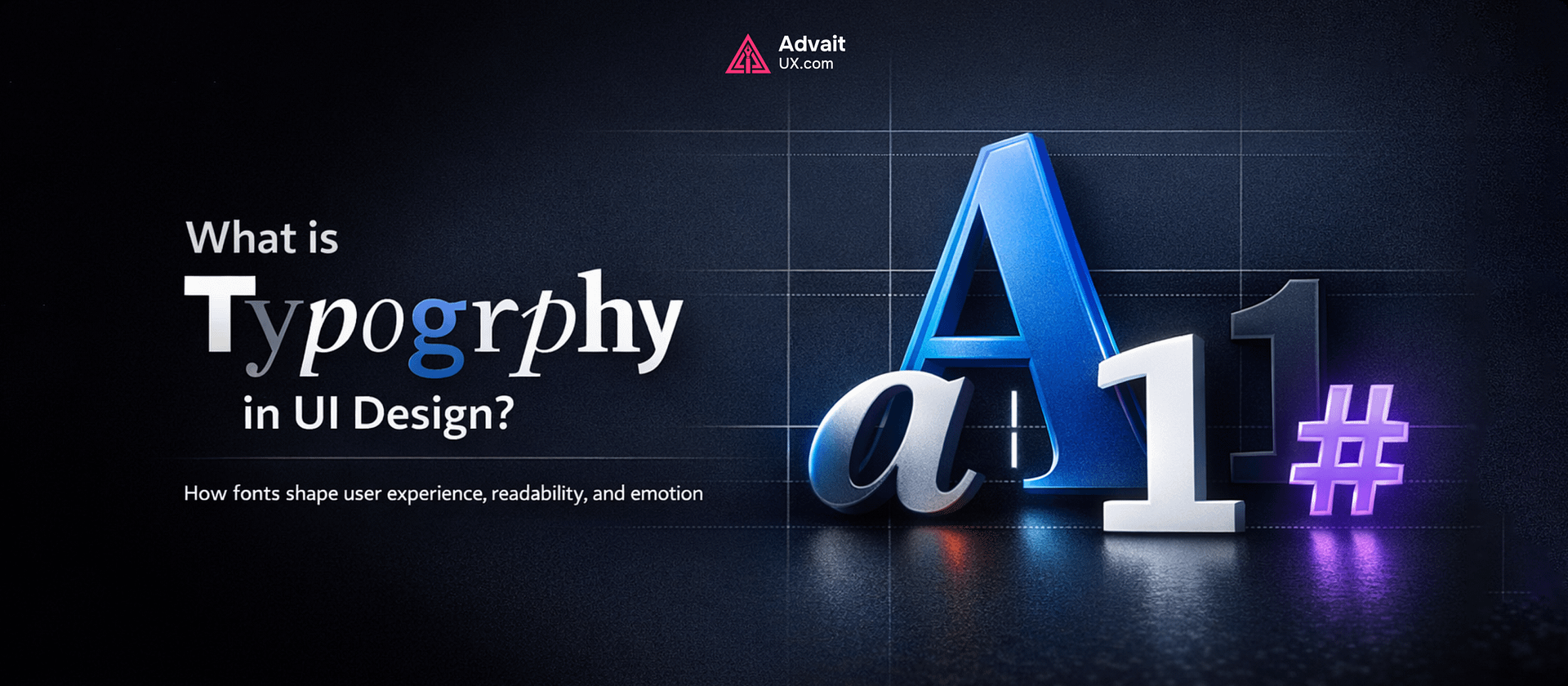
Short answer: Typography in UI drives readability, hierarchy, brand tone, and accessibility. Strong UI type makes content scannable and trustworthy. Best-practice basics: 1–2 typefaces, a clear scale (12/14/16/20/24/32), line length of 50–75 characters, WCAG-compliant contrast, and weight — not just size — for hierarchy. (Further reading: Material Design — type system.)
📅 Last updated: June 6, 2026
⏱ 5 min read · 1,027 words
Related reading: see the core principles of UX design and information architecture. Want help applying this to your product? Explore our UI/UX design services.
Most users won’t notice your typography.
But they will notice when something feels off.
They hesitate. They reread. They lose patience. And eventually, they leave.
That’s the real impact of typography in UI —it quietly shapes how users experience your product. Not visually, but behaviourally. In every high-performing product today, typography isn’t treated as decoration.
It’s treated as a system. And any serious UI UX Design Company knows that getting typography right is often the difference between engagement and abandonment.
The Truth Most Designers Learn Too Late
Typography is not about fonts.
It’s about control.
Control over how users scan your interface.
Control over what they notice first.
Control over how effortlessly they understand your content.
When typography is done right, users don’t think—they move. Smoothly, naturally, without friction.
That’s what great ui ux work looks like. Invisible, but powerful.
Why Typography Directly Impacts Conversions
Let’s move beyond theory.
Typography Affects Business outcomes.
If users struggle to read:
- They don’t trust the product
- They don’t stay long
- They don’t convert
Simple as that.
On the other hand, when typography feels clear and structured:
- Users move faster
- Information feels easier to digest
- Decisions happen quicker
A skilled UX Design Agency doesn’t just for aesthetics—they for decisions.
How Users Actually Read Interfaces
Here’s something many teams overlook:
Users don’t read your content. They scan it.
They jump between headings.
They skim for keywords.
They look for visual anchors.
Typography determines whether that scanning experience feels effortless—or exhausting.
If your hierarchy is weak, users get lost.
If your spacing is off, they lose rhythm.
If your contrast is poor, they stop trying.
Typography isn’t just about readability. It’s about flow.
The Core Principles That Separate Good from Great
You don’t need complex theory to improve typography. You need clarity in execution.
1. Hierarchy Creates Direction
Users should never have to guess where to look.
Strong hierarchy answers three questions instantly:
- What is this page about?
- What should I read first?
- What matters most?
Without hierarchy, your interface becomes noise.
This is where most average designs fail—and where great UI UX service stands out.
2. Readability Builds Trust
If your content feels difficult to read, users don’t blame themselves—they blame your product.
Readable typography creates:
- Comfort
- Confidence
- Continuity
It’s subtle, but powerful.
And it’s non-negotiable in professional UI UX Work.
3. Spacing Controls Experience
Spacing is what turns text into an experience.
Too tight, and it feels stressful.
Too loose, and it feels disconnected.
The right spacing creates rhythm—something users don’t notice consciously, but feel immediately.
This is where design moves from visual to experiential.
4. Consistency Removes Friction
Inconsistent typography creates doubt.
Different font sizes, random spacing, uneven styles—it all adds friction.
Consistency, on the other hand, makes everything feel intentional.
And when things feel intentional, users trust the product more.
That’s why every experienced ui ux company builds structured typography systems—not just screens.
5. Contrast Drives Accessibility
Typography that looks good but isn’t readable is failed design.
Real users interact with products in real conditions:
- Bright sunlight
- Low battery screens
- Different devices
Strong contrast ensures your content works everywhere—not just in design previews.
Accessibility isn’t an add-on anymore. It’s a baseline.
Where Most Businesses Get It Wrong
Here’s what typically happens:
Teams invest heavily in visuals—colors, animations, layouts—but underestimate typography.
It’s treated as a final step.
“Just pick a font and move on.”
But that shortcut shows up later:
- Users feel confused
- Content feels heavy
- Bounce rates increase
At AdvaitUX, typography is never an afterthought. It’s part of the foundation.
Because in real-world projects, clarity always outperforms creativity.
What Great Typography Feels Like
Look at products you enjoy using.
Not because they look flashy—but because they feel easy.
That ease comes from:
- Clear structure
- Balanced spacing
- Effortless readability
You don’t notice it. You just stay longer.
That’s the goal every serious ux agency should aim for.
A Practical Perspective from Real UX Work
In real projects, typography decisions are rarely about style—they’re about trade-offs.
Should we reduce text to improve clarity?
Should we increase spacing for better scanning?
Should we simplify hierarchy to reduce confusion?
These are the questions that shape real outcomes.
At AdvaitUX, we’ve seen firsthand how small typography changes can:
- Improve engagement
- Reduce user drop-offs
- Increase conversion rates
Not because they look better—but because they work better.
Final Thought: Typography Is the Difference You Feel
Users may not point at typography and say, “This is great.”
But they will feel it.
They’ll feel when things are easy.
They’ll feel when things are frustrating.
And that feeling determines whether they stay—or leave.
Typography is not a detail. It’s the experience behind the experience.
If Your Product Feels “Off,” This Might Be Why
If users aren’t engaging the way you expect, the problem isn’t always features or design complexity.
Sometimes, it’s clarity.
And clarity starts with typography.
At AdvaitUX, we help businesses fix exactly that—by designing interfaces that are not just visually clean, but genuinely usable.
If you want your product to feel smoother, clearer, and easier to use, it’s worth having a conversation.
Visit AdvaitUX.com and explore how we approach UX differently.
💡 Working on your own product? Start with a structured UX audit to surface the highest-impact friction in 1–3 weeks, or get in touch to scope a project with our Austin-based team.
Frequently Asked Questions
Why is typography important in UI design?
Typography drives readability, hierarchy, brand tone, and accessibility. Strong UI type makes content scannable and trustworthy; weak type makes even good content feel unprofessional and hard to use.
What are the basics of good UI typography?
Limit yourself to 1–2 typefaces, use a clear type scale (e.g. 12/14/16/20/24/32), keep line length 50–75 characters, maintain WCAG contrast ratios, and use weight — not just size — for hierarchy.
About the Author
Darshan Italiya is the Founder & UX Lead at AdvaitUX, a UI/UX design agency based in Austin, TX. A Google-certified UI designer with 7+ years of experience and 70+ shipped product designs, he writes about user-centered design, UX strategy, and conversion-focused interfaces. Learn more about AdvaitUX or connect on LinkedIn.