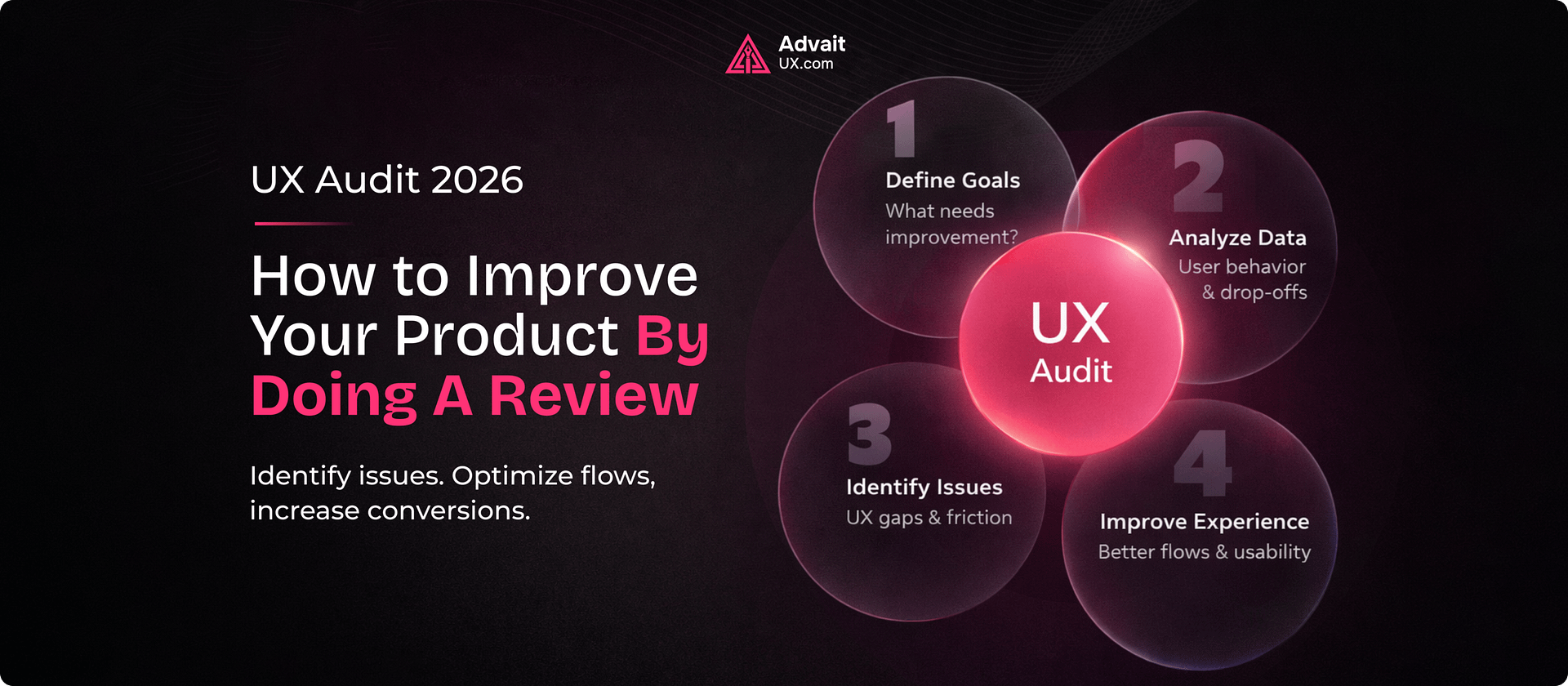
Short answer: A UX design audit reviews a live product against usability heuristics, real user data, and accessibility standards. The output is a prioritised list of friction points with severity ratings and specific fixes — turning vague usability complaints into a concrete fix backlog. (Further reading: NN/g — 10 usability heuristics.)
📅 Last updated: June 6, 2026
⏱ 6 min read · 1,329 words
This article is part of our guide on what happens during a UX design audit.
A great product is never truly “finished.” Even well-designed interfaces can develop usability issues over time as user behavior evolves. That’s why a UX Design Audit is essential.
A UX audit is a structured review of your product’s user experience. It helps identify usability gaps, friction points, and missed opportunities that affect performance. Whether you run a startup or a growing business, auditing your product can lead to better engagement, higher conversions, and improved customer satisfaction.
If you’re investing in a UI UX Design Service, understanding how audits work will help you make smarter product decisions.
What Is a UX Design Audit?
A UX design audit is a detailed evaluation of a digital product’s usability, accessibility, and overall user experience.
It answers key questions like:
- Where are users struggling?
- What causes drop-offs or confusion?
- Which design elements reduce efficiency?
- How can the experience be improved?
Unlike guesswork, an audit uses real data, user behavior insights, and design principles to uncover issues.
For any business working with a User Experience Design Services provider, a UX audit is often the first step toward meaningful improvement.
Why Is a UX Audit Important?
Many products fail not because of poor ideas, but because of poor execution. A UX audit helps bridge that gap.
Key Benefits of a UX Audit
1. Identifies Usability Issues
Small design flaws can create major friction. An audit highlights these hidden problems.
2. Improves Conversion Rates
Better usability leads to smoother user journeys and higher conversions.
3. Enhances User Satisfaction
When users find your product easy and intuitive, they are more likely to return.
4. Reduces Development Costs
Fixing issues early prevents costly redesigns later.
5. Aligns Business and User Goals
A strong audit ensures your product supports both user needs and business objectives.
For companies aiming to become the Best UI UX Design Company,regular audits are not optional — they are essential.
When Should You Conduct a UX Design Audit?
Timing matters. A UX audit is most effective when done at the right stage.
Ideal Situations for a UX Audit
- Before a product redesign
- After noticing a drop in conversions
- When launching a new feature
- During scaling or growth phases
- When user feedback highlights issues
Even well-performing products benefit from periodic audits.
How to Perform a UX Design Audit
A UX audit follows a structured process. Below are the key steps used by UX Design professionals.
1. Define Goals and Metrics
Start by identifying what you want to achieve.
Examples:
- Increase sign-ups
- Reduce bounce rates
- Improve task completion time
Clear goals help you focus your audit and measure success.
2. Analyze User Behavior
Use analytics tools to understand how users interact with your product.
Look for:
- Drop-off points
- Navigation patterns
- High-exit pages
- Time spent on tasks
This data shows what users do — not what they say.
3. Evaluate Usability Heuristics
Heuristic evaluation involves reviewing your product against established usability principles.
Focus on:
- Consistency
- Visibility of system status
- Error prevention
- Ease of navigation
This step is commonly used by every professional ui ux design service provider.
4. Conduct User Testing
Real user feedback is critical.
Observe users as they interact with your product and note:
- Where they struggle
- What confuses them
- How long tasks take
Even a few sessions can reveal valuable insights.
5. Review Information Architecture
Check how your content and navigation are structured.
Ask:
- Can users find what they need quickly?
- Is navigation intuitive?
- Are categories clear and logical?
Good structure is the backbone of usability.
6. Assess Visual Design and Accessibility
Design is not just about aesthetics. It also affects usability.
Evaluate:
- Readability of text
- Contrast and color usage
- Button visibility
- Mobile responsiveness
Accessibility ensures your product works for all users.
7. Identify Key Issues and Prioritize
Not all problems are equally important.
Group findings into:
- High-impact issues (urgent fixes)
- Medium-impact improvements
- Low-priority enhancements
This helps teams take action efficiently.
Common UX Problems Found in Audits
Most UX audits reveal similar patterns of issues.
1. Complex Navigation
Too many options overwhelm users and slow decision-making.
2. Poor Mobile Experience
Designs that don’t adapt properly to smaller screens create frustration.
3. Unclear Call-to-Actions
If users don’t know what to do next, they leave.
4. Inconsistent Design
Different styles across pages reduce trust and clarity.
5. Slow Load Times
Performance directly impacts user experience and retention.
Fixing these issues can significantly improve product performance.
How a UX Audit Improves Business Outcomes
A UX audit is not just about design — it directly impacts business results.
Improved Conversions
Simplified user journeys increase sign-ups and purchases.
Reduced Support Costs
Better usability means fewer customer complaints.
Stronger Brand Trust
A smooth experience builds credibility and loyalty.
Better Product Decisions
Data-driven insights guide smarter design changes.
This is why companies invest in professional user experience design services to stay competitive.
Real-World Experience: How AdvaitUX Conducts UX Audits
At AdvaitUX, UX audits are not surface-level reviews. They are deep, data-driven evaluations based on real user behavior.
Our approach includes:
- Studying analytics and user flows
- Identifying friction points across journeys
- Conducting usability testing sessions
- Reviewing design consistency and accessibility
- Providing actionable recommendations
In one recent project, a SaaS platform experienced high drop-offs during onboarding. After conducting a UX audit, we simplified the flow, improved clarity, and reduced friction. The result was a noticeable increase in user activation.
In another case, optimizing navigation and CTA placement improved conversions without changing the core product.
These outcomes come from real experience — not assumptions.
Who Should Consider a UX Audit?
A UX audit is valuable for:
- Startups building their first product
- Growing businesses scaling their platform
- SaaS companies improving user retention
- E-commerce brands optimizing checkout flows
- Any business working with a ui ux design service
If your product has users, it can benefit from a UX audit.
Conclusion: Why UX Audits Are Essential for Growth
A UX design audit is one of the most effective ways to improve your product without starting from scratch.
It helps you understand what’s working, what’s not, and where to focus your efforts.
By identifying usability issues, optimizing user flows, and aligning design with user behavior, you create a product that is easier to use, more engaging, and more effective.
From our experience at AdvaitUX, even small improvements uncovered during audits can lead to significant business impact.
Let’s Improve Your Product Experience
At AdvaitUX, we provide expert-led UX audits and design solutions tailored to real user needs. As a team focused on delivering high-quality user experience design services, we help businesses create products that are both functional and meaningful.
If you’re looking for the Best UI UX Design Company to review and improve your product, our team is here to help.
Reach out to AdvaitUX today and take the first step toward a better user experience.
Need a professional UX audit in Austin, TX? Our UI/UX design agency in Austin specializes in product audits that surface high-impact fixes in 1–3 weeks.
Ready to improve your product? Our professional UX audit service identifies every usability issue with clear, prioritized recommendations — delivered in 7 days. Get started today.
Ready to improve your product? Our professional UX audit service identifies every usability issue with clear, prioritized recommendations — delivered in 7 days. Get started today.
💼 Want proof of concept? Browse our recent UI/UX projects to see how we apply this to real products.
About the Author
Darshan Italiya is the Founder & UX Lead at AdvaitUX, a UI/UX design agency based in Austin, TX. A Google-certified UI designer with 7+ years of experience and 70+ shipped product designs, he writes about user-centered design, UX strategy, and conversion-focused interfaces. Learn more about AdvaitUX or connect on LinkedIn.