Key Takeaways
- Great UX is no longer optional — it’s a core driver of conversions, retention, and revenue.
- Users compare your product against the best digital experience they used yesterday, not just your direct competitors.
- UI design and UX design are related but distinct disciplines, and both matter for a successful product.
- Research-driven design decisions consistently outperform decisions based on internal opinion.
- A structured design process — from discovery through testing — reduces costly rework later.
- Design systems make it possible to scale a product without sacrificing consistency.
- Different industries face different UX constraints, and experience matters when navigating them.
- Usability testing catches expensive problems while they’re still cheap to fix.
- Accessibility isn’t optional — it broadens your market and reduces legal exposure.
- Working with an experienced UI UX design agency like AdvaitUX shortens the path between an idea and a product users genuinely enjoy using.
Great Products Don’t Fail on Features. They Fail on Experience.
Most businesses don’t lose customers because their product lacks features. They lose customers because the product is confusing, slow to learn, or simply frustrating to use. A visitor lands on your site, opens your app, or logs into your dashboard, and within seconds decides whether to stay or leave.
That decision has almost nothing to do with your backend architecture or your pricing model. It has everything to do with User-Centered Design.
Customer expectations have shifted permanently. People have used enough well-designed apps — Stripe, Linear, Notion, Airbnb — that they now compare your product against the best experience they used yesterday, not just your direct competitors. If your onboarding takes six steps when it should take two, if your dashboard buries the one action users need most, or if your checkout flow adds friction at the exact moment someone is ready to buy, you are losing revenue you never see reported anywhere.
This is why user experience has become a genuine competitive advantage rather than a “nice to have.” Companies that invest early in UI UX design outperform competitors on conversion rate, customer retention, and word-of-mouth growth. Companies that treat design as an afterthought spend years fighting churn they could have prevented with better decisions at the start.
AdvaitUX exists to close that gap. We work as an embedded design partner — not a vendor who disappears after delivering a Figma file — helping you make research-backed decisions about how your product looks, feels, and functions at every touchpoint.
Why Choose AdvaitUX?
User-Centered, Not Trend-Centered. We design around how your actual users think and behave, not whatever visual trend is popular on design Twitter this month. Trends fade. Usability doesn’t.
Business-Focused Strategy. Every design decision is tied to a metric — activation rate, checkout completion, support ticket volume, time-to-value. We’re not decorating your product; we’re optimizing it.
Research-Driven Decisions. We don’t guess what users want. We ask them, watch them, and test with them, so design choices are backed by evidence rather than internal opinion.
Modern, Confident UI. Clean, contemporary interfaces that feel current without chasing novelty for its own sake — built to age well as your product scales.
Fast, Transparent Collaboration. Weekly check-ins, shared Figma files from day one, and a process that keeps your team informed instead of waiting weeks for a “big reveal.”
Scalable Design Systems. We build component libraries and design systems that your engineering team can actually implement, so design doesn’t become a bottleneck as you grow.
Cross-Platform Expertise. Web, mobile, SaaS dashboards, enterprise tools — our team has shipped across platforms and understands the constraints unique to each one.
Our UI UX Design Services
AdvaitUX offers full-cycle UI UX design services for companies at every stage — from early-stage start-ups validating their first product to enterprises redesigning systems used by thousands of employees.
UI Design
Interface design is where strategy becomes visible. Our UI design services cover visual hierarchy, typography, color systems, iconography, and interaction states, all built to guide users toward the actions that matter to your business. We care about interfaces looking sharp, but a beautiful screen that confuses someone is still a screen that failed at its job — so we design for instant understanding first, polish second.
UX Design
UX design is the structural work beneath the visuals: how information is organized, how users move through your product, and how easy it is to accomplish a goal. Our UX design process focuses on reducing friction at every step, from first impression to core workflow, so users reach value faster and stay longer.
UX Research
Good design starts with understanding real user behavior, not assumptions. Our UX research services include user interviews, surveys, behavioral analytics review, and competitive analysis. We use this research to identify where users struggle, what they actually need, and where the biggest opportunities for improvement exist.
Product Strategy
Before we design a single screen, we help clarify what the product needs to achieve. Our product strategy work aligns business goals, user needs, and technical constraints into a clear roadmap, so design decisions later in the process are fast and confident rather than debated from scratch.
Wireframing
Wireframing lets us test structure and flow before investing time in visual design. We build low-fidelity wireframes that map out layout, navigation, and content priority, giving your team an early, low-cost way to validate direction before anything is set in stone.
Interactive Prototypes
Static mockups can hide usability problems that only surface once a product feels real. Our interactive prototypes simulate actual user flows — clickable, testable, and close enough to the finished product that you can validate decisions with real users before development begins.
Design Systems
As products grow, inconsistent UI becomes a tax your team pays over and over. We build design systems — reusable components, defined patterns, and clear documentation — that keep your product visually consistent and let your engineering team ship new features faster, without reinventing buttons and forms every sprint.
Mobile App Design
Mobile users have different expectations, attention spans, and interaction patterns than desktop users. Our mobile app UI UX design accounts for thumb reach, one-handed use, offline states, and platform-specific conventions on iOS and Android, so your app feels native rather than like a shrunk-down website.
Web Application Design
Web applications need to balance functionality with clarity, often packing complex features into a small number of screens. We design web application interfaces that stay usable as functionality grows, avoiding the common trap of dashboards that become harder to navigate with every new feature release.
SaaS Dashboard Design
Dashboards live or die on information hierarchy. Our SaaS UI UX design work focuses on surfacing the data and actions users need most, reducing cognitive load, and designing for the daily, repeat use that defines most SaaS products — because a dashboard people dread opening is a retention risk.
Enterprise UX
Enterprise software often serves multiple user roles, complex permissions, and legacy workflows that can’t be redesigned overnight. Our enterprise UX design process respects these constraints while still improving usability incrementally, focused on reducing training time and internal support requests.
Website Redesign
A website redesign is a high-stakes UI UX project — done poorly, it can tank conversions and confuse returning visitors. We approach redesigns methodically: auditing what’s currently working, identifying what isn’t, and rebuilding with a clear rationale behind every change, not just a visual refresh.
Landing Page Design
Landing pages carry the weight of a single decision: convert or lose the visitor. Our landing page design combines conversion-focused UX design principles with clear messaging hierarchy, built to guide visitors toward one primary action instead of scattering their attention across too many choices.
Usability Testing
We validate design decisions with real users before they become expensive development work. Our usability testing sessions surface friction points, confusing labels, and unexpected user behavior early, so problems get caught in a Figma prototype instead of a support ticket queue.
Accessibility Design
There’s a common misconception that accessibility work is only about compliance checkboxes. In practice, it tends to make products better for everyone, not just the users it was designed for. We build interfaces that follow WCAG guidelines, ensuring your product is usable by people with visual, motor, and cognitive differences — which also broadens your addressable market and reduces legal risk.
UX Audit
If you already have a live product, a UX audit gives you a clear, prioritized view of what’s holding back conversions, retention, or engagement. We review your product against usability heuristics, analytics data, and industry benchmarks, then deliver a practical roadmap — not just a list of complaints.
Industries We Serve
Different industries carry different UX constraints — regulatory requirements, user expertise levels, and business models that shape what “good design” actually means. Our experience spans:
SaaS. Subscription products live or die on activation and retention. We focus on onboarding flows that get users to their first “aha moment” quickly, and dashboard designs that keep them coming back daily.
Healthcare. Healthcare UI UX design has to balance usability with accuracy, compliance, and the reality that users may be stressed, tired, or in a hurry. We design for clarity above all — mistakes in healthcare interfaces carry real consequences.
FinTech. Fintech UX design requires building trust fast. Users are handing over sensitive financial information, so clarity, transparency, and a sense of security need to be designed into every screen, not bolted on afterward.
Real Estate. Real estate platforms need to make large, complex datasets — listings, filters, comparisons — feel simple to browse, whether on a desktop research session or a mobile search while standing outside a property.
AI Companies. AI products often involve unfamiliar interaction patterns. We help AI companies design interfaces that make complex or “black box” functionality feel understandable and controllable to everyday users.
EdTech. Educational products serve wildly different age groups and skill levels. We design for engagement and comprehension, keeping interfaces simple enough not to distract from learning.
Logistics. Logistics platforms are often data-dense and used by operations teams under time pressure. We prioritize speed and clarity over visual flourish, since every extra click costs real operational time.
Travel. Travel UX blends inspiration with transaction — users need to browse, compare, and book with confidence. We design flows that reduce decision fatigue during high-consideration purchases like flights and hotels.
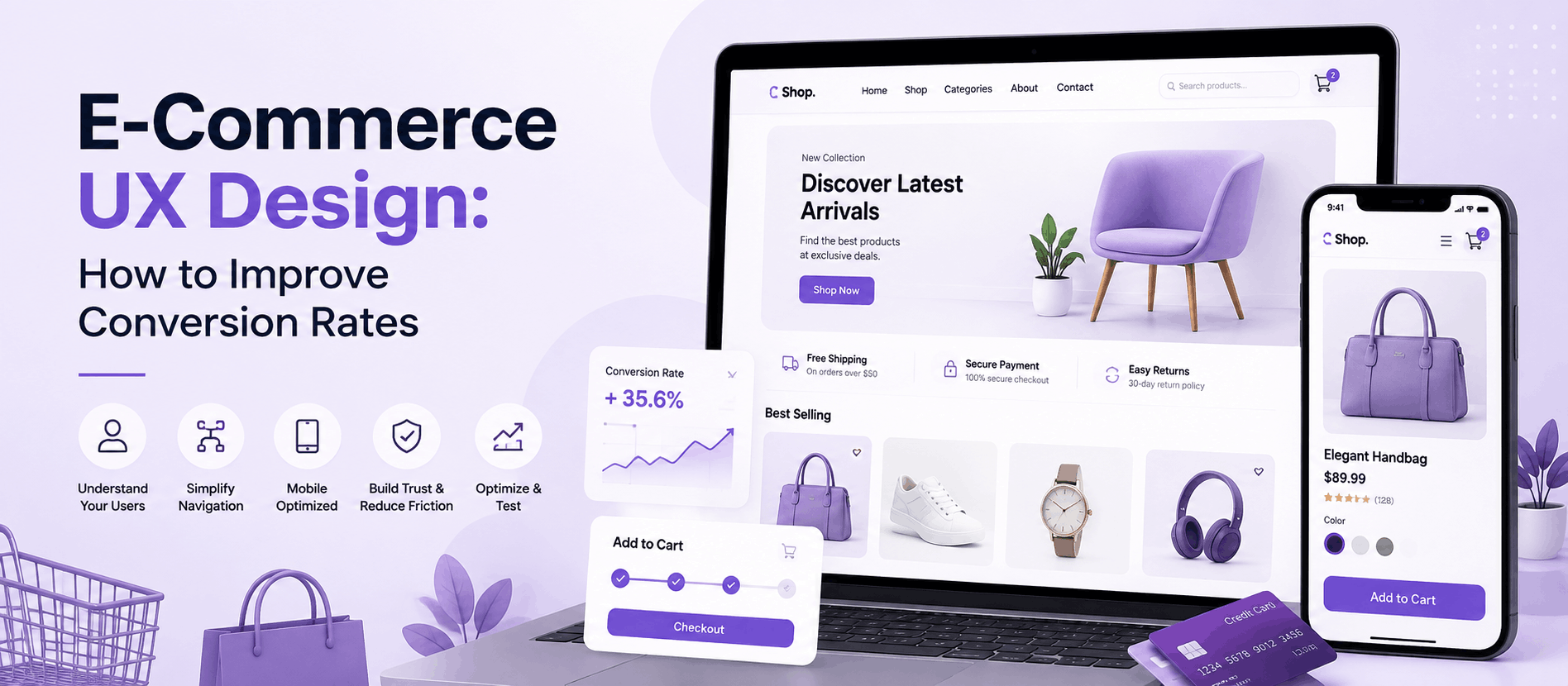
E-commerce. Every extra step in a checkout flow costs conversions. We design product discovery and checkout experiences focused on removing friction between browsing and buying.
Manufacturing. Manufacturing software often involves internal tools with steep learning curves. We simplify these interfaces to reduce training time and operator error on the floor.
Our UI UX Design Process
We follow a structured process that keeps projects moving, keeps you informed, and ensures design decisions are grounded in evidence rather than opinion.
1. Discovery. We start by understanding your business goals, target users, technical constraints, and what success actually looks like for this project.
2. User Research. We talk to real users — or your existing customers — to understand their needs, frustrations, and behavior patterns before we design anything.
3. Competitor Analysis. We study how competitors and category leaders solve similar problems, identifying both patterns worth adopting and mistakes worth avoiding.
4. Information Architecture. We map out how content and features should be organized, so navigation feels logical rather than arbitrary.
5. User Flows. We chart the step-by-step paths users take to complete key tasks, identifying and removing unnecessary friction before any visual design begins.
6. Wireframes. We build low-fidelity layouts to validate structure and priority early, when changes are still cheap to make.
7. UI Design. We apply your brand and visual language to build polished, on-brand interfaces grounded in the wireframed structure.
8. Interactive Prototype. We connect screens into a clickable prototype that simulates the real product experience for testing and stakeholder review.
9. Usability Testing. We test the prototype with real users, watching where they hesitate, misclick, or get confused, and refine accordingly.
10. Developer Handoff. We deliver organized, developer-ready files with specs, assets, and documentation, so nothing gets lost in translation during build.
11. Continuous Improvement. After launch, we help track how the design performs against real usage data and iterate based on what users actually do.
Why UX Matters for Business Growth
Too many teams still treat design as a cost center, something you fund once and hope pays off. In our experience, it’s one of the highest-leverage investments a product team can make. Here’s where that shows up in the numbers that matter to your business:
Conversions. Removing friction from signup flows, checkout processes, or lead forms directly increases the percentage of visitors who take action. A confusing form is a silent conversion killer.
Customer Satisfaction. Products that are intuitive to use generate fewer frustrated support tickets and more positive reviews, directly shaping how customers perceive your brand.
Retention. Users stay with products that make them feel capable and in control. Confusing interfaces quietly push users toward competitors, often without ever filing a complaint.
Revenue. Better onboarding means faster activation. Faster activation means more users reach paid plans or repeat purchases sooner, compounding revenue over time.
Engagement. Interfaces that reduce cognitive load make it easier for users to return regularly, which matters enormously for subscription and SaaS business models.
Reduced Support Costs. Every point of confusion in your product becomes a support ticket, a churned customer, or both. Clear design prevents problems before they reach your support team.
Higher Product Adoption. New features only create value if users discover and understand them. Thoughtful UX design ensures new functionality gets used, not ignored.
Why Businesses Choose AdvaitUX
Experienced UX Specialists. Our team has worked across SaaS, healthcare, fintech, and enterprise products, bringing pattern recognition you can’t get from a generalist design shop.
Strategic Thinking. We push back on design requests that don’t serve a business goal, and we ask “why” before we ask “what color.”
Data-Driven Design. Wherever possible, decisions are informed by research, testing, and analytics — not internal preference or the loudest voice in the room.
Transparent Communication. You’ll always know what stage a project is in, what’s next, and why a decision was made. No black-box design process.
Faster Project Delivery. Our process is structured to avoid the endless revision loops that stall so many design engagements.
Scalable Design Systems. We build for where your product is going, not just where it is today, so design doesn’t need to be rebuilt every time you grow.
Long-Term Partnership. Many of our clients work with us continuously as their product evolves, rather than as a one-time project.
Our Design Principles
Simplicity. We remove anything that doesn’t help the user accomplish their goal. Simplicity isn’t about having fewer features — it’s about presenting the right ones clearly.
Accessibility. Interfaces should work for users with a wide range of abilities, not just the “average” user assumed by default design patterns.
Consistency. Predictable patterns reduce the mental effort required to use a product, which is why consistent components and behavior matter more than novelty.
Performance. A beautiful interface that loads slowly or feels sluggish is still a poor experience. We design with technical performance in mind, not just visuals.
Mobile-First. With most digital traffic happening on mobile devices, we design for smaller screens first and scale up, rather than the reverse.
Human-Centered Design. Every decision starts from the question: what does the person using this actually need in this moment?
Scalability. We design systems that can grow with new features and use cases, instead of interfaces that need a full rebuild every year.
Common UI UX Problems We Solve
Low Conversions. Often caused by unclear value propositions, cluttered forms, or too many competing calls to action. We simplify the path to conversion and remove decision fatigue.
Poor Onboarding. New users abandon products that take too long to show value. We redesign onboarding to get users to their first meaningful action as quickly as possible.
High Bounce Rates. Usually a sign that visitors can’t quickly understand what you offer or why it matters to them. We fix messaging hierarchy and first-impression clarity.
Complicated Dashboards. Feature creep tends to bury the actions users care about most. We restructure information architecture to prioritize what matters.
Confusing Navigation. When users can’t find what they need, they leave. We simplify navigation structures based on how users actually think about your product, not how your internal team organized it.
Low Engagement. Often tied to friction, unclear next steps, or interfaces that don’t reward return visits. We redesign flows to encourage habitual use.
Weak Mobile Experience. A desktop-first design squeezed onto a small screen frustrates mobile users. We design mobile experiences natively, not as an afterthought.
Why Modern Businesses Invest in UX
Digital Transformation. As more business processes move online, the digital experience stops being a supporting layer and starts being the business itself.
AI Products. AI-powered tools introduce new interaction patterns that users are still learning. Thoughtful UX design determines whether users trust and adopt these tools or abandon them out of confusion.
Competitive Advantage. In crowded markets, product experience is often the deciding factor between otherwise similar offerings.
Customer Expectations. Users now expect the same polish from a niche B2B tool that they get from consumer apps they use daily. Falling short of that bar creates a quiet but real disadvantage.
Product Growth. Sustainable growth depends on retention as much as acquisition, and retention is largely a design problem — do users find enough value, easily enough, to stay?
DIY Design vs. Professional UI UX Agency
| Factor | DIY / In-House Attempt | AdvaitUX (Professional Agency) |
|---|---|---|
| Research | Based on internal assumptions | Grounded in real user interviews and testing |
| Quality | Inconsistent, dependent on individual skill | Consistent, backed by structured process and review |
| Speed | Often slowed by internal bottlenecks and indecision | Structured timelines with dedicated design resources |
| Scalability | Ad-hoc patterns that break down as product grows | Design systems built to scale with your product |
| ROI | Hard to measure; often reactive fixes | Tied to measurable outcomes like conversion and retention |
| Long-Term Value | Requires frequent rework as issues surface | Reduces costly redesigns through upfront research and testing |
How Clients Benefit From Working With AdvaitUX
Better User Experience. Interfaces that are easier to learn, faster to use, and more enjoyable to return to.
Higher Conversions. Reduced friction across signup, checkout, and key workflows translates directly into more completed actions.
Stronger Branding. A polished, consistent visual identity that builds trust and credibility from the first impression.
Faster Development. Clear design systems and developer-ready handoffs mean less back-and-forth and fewer implementation delays.
Lower Redesign Costs. Getting UX right the first time — backed by research and testing — reduces the need for expensive rebuilds down the line.
Happier Users. Products that respect users’ time and attention build loyalty that’s difficult for competitors to erode.
Frequently Asked Questions
1. What does a UI UX design agency do?
A UI UX design agency researches user needs, designs interfaces and workflows, and tests those designs to ensure a digital product is easy to use and achieves business goals. This includes everything from research and wireframing to final visual design and developer handoff.
2. Why should I hire a UI UX agency?
Hiring a dedicated agency brings specialized expertise, an outside perspective on usability issues your team may not notice, and a structured process that reduces the risk of costly redesigns after launch.
3. What industries does AdvaitUX serve?
We work with SaaS, healthcare, fintech, real estate, AI, EdTech, logistics, travel, e-commerce, and manufacturing companies, among others, adapting our approach to the specific constraints of each industry.
4. What is included in UI UX design services?
Our services include UX research, product strategy, wireframing, UI design, interactive prototyping, design systems, usability testing, accessibility design, and UX audits, depending on project needs.
5. How long does a UI UX project take?
Timelines vary based on scope. A landing page or small feature redesign may take a few weeks, while a full product design engagement can take several months. We provide a clear timeline during discovery.
Conclusion
None of this works if it stays theoretical, so here’s the short version: design isn’t decoration you add at the end of a project, and it isn’t a department that only gets involved once engineering has already built something. It’s the layer your customers actually experience, and it quietly decides whether they stick around, tell a friend, or quietly churn without ever explaining why.
We’ve seen the same pattern play out across SaaS tools, healthcare platforms, and fintech apps — the products that grow sustainably are rarely the ones with the most features. They’re the ones that are easiest to understand on day one and still make sense six months later, once real usage has piled up around them.
That’s the standard AdvaitUX designs to. Not “does it look modern,” but “does this actually work for the person using it, and does it move the business forward at the same time.” If that’s the kind of partner you’re looking for — one that treats research, structure, and business outcomes as seriously as visual polish — we’d like to hear about your product.