Mobile apps live or die by experience.
If users feel confused, slow, or frustrated, they leave within seconds. No second chances. No polite goodbyes. uninstall.
That’s why smart product teams don’t treat design as decoration anymore. They invest in UX Design Services that shape how people think, move, and succeed inside the app.
This guide explains mobile app UX. It covers all phases. It shows how a strategy-led agency like AdvaitUX turns ideas into fun products.
What Is Mobile App UX Design Services?
Mobile UX Design Services focus on creating apps that are:
- Easy to understand
- Fast to navigate
- Accessible to all users
- Built around real behaviour
It’s not UI screens or pretty visuals.
It’s research, strategy, testing, and iteration. Every tap, swipe, and interaction are intentional.
Think of it this way: UI is how it looks. UX Design Services are how it works and feels.
And feelings are what drive retention.
Why UX Matters More Than Ever (The Real UX Importance)
Users compare your app to the best experiences they’ve ever had.
Not just competitors. Everything.
If your checkout takes 5 steps while another takes 2, you lose. If onboarding is confusing, users churn. If performance feels slow, trust drops instantly.
That’s the true UX Importance:
- Higher retention
- Fewer support tickets
- Better app store ratings
- Increased conversions
- Lower development rework
Good UX isn’t a cost. It’s risk reduction and growth insurance.
When Should You Invest in UX Design?
Teams often wait too long.
But UX should happen before development, not after launch.
Here’s when it matters most:
1. New mobile app idea
Start with research and validation. Don’t build blind.
2. Low engagement or churn
Users dropping off? Time for a UX Design Audit.
3. Redesign or scaling
Features multiply. Complexity grows. UX Design Services keeps things usable.
4. Entering competitive markets
Differentiation comes from experience, not features alone.
If users feel friction, design is usually the root cause.
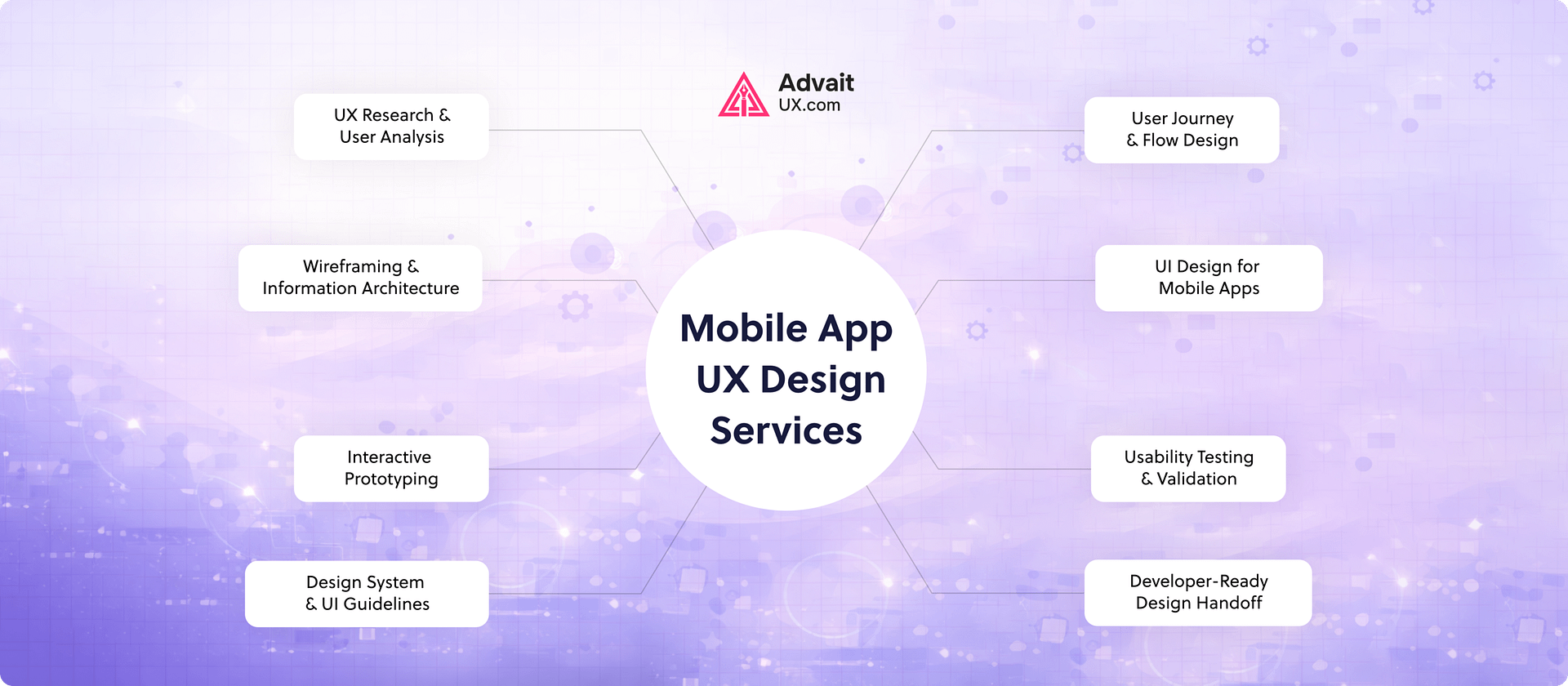
Core Stages of Mobile App UX Design Services
Professional UX Design Services isn’t guesswork. It’s a structured process.
Let’s walk through what typically happens inside an agency-led project.
Stage 1: Discovery & Research
Everything starts with understanding people.
Not assumptions. Not stakeholder opinions.
Real data.
This includes:
- User interviews
- Behaviour analysis
- Competitor benchmarking
- Market research
- Analytics review
At this stage, we ask simple questions:
- Who are the users?
- What are they trying to achieve?
- Where do they struggle today?
Without this, design is just decoration.
With it, design becomes strategy.
Stage 2: UX Strategy & Information Architecture
Now we translate insights into structure.
This is where we define:
- User journeys
- Task flows
- Feature prioritization
- Navigation models
- Content hierarchy
Imagine constructing the blueprint before the house.
A clear structure prevents feature clutter and cognitive overload.
Many teams skip this and end up redesigning later. That’s expensive.
Stage 3: Wireframing & Interaction Design
Next comes low-fidelity design.
Wireframes show:
- Screen layouts
- Content placement
- Interaction logic
No colours yet. No visual polish.
Just clarity.
This step helps teams align quickly and test ideas before writing a single line of code.
It saves time, money, and frustration.
Stage 4: UI Design & Visual Systems
Now the product gets its personality.
Here we design:
- Visual identity
- Typography
- Colour systems
- Icons
- Components
- Design systems
But visuals aren’t just about aesthetics.
They guide attention, reduce errors, and improve usability.
Good interface design feels invisible. Users just “get it.”
Stage 5: Prototyping & Usability Testing
Before launch, we simulate the real app.
Interactive prototypes let users:
- Complete tasks
- Navigate flows
- Provide feedback
We watch where they hesitate or fail.
That’s gold.
Small insights here prevent massive issues later.
Testing turns opinions into evidence.
Stage 6: Handoff & Continuous Optimization
UX doesn’t end at launch.
It evolves.
After release, teams track:
- Drop-offs
- Heatmaps
- Session recordings
- Conversion rates
Then iterate.
The best apps treat UX as an ongoing process, not a one-time project.
What Happens During a UX Design Audit?
If you already have an app, a UXDesign Audit is often the fastest way to improve results.
It’s like a health check.
Experts check:
- Navigation clarity
- User flows
- Accessibility
- Performance friction
- Conversion leaks
- Consistency issues
Then you get prioritized recommendations.
Not vague advice. Clear, actionable fixes.
Many businesses see measurable improvements within weeks after implementing audit insights.
Benefits of User Experience Design for Businesses
Let’s talk outcomes.
Because leadership cares about results, not just design theory.
Here are the real benefits of user experience design:
- Faster onboarding
- Higher task completion
- More purchases or signups
- Fewer complaints
- Reduced development rework
- Stronger brand trust
And one underrated benefit?
Internal alignment.
When UX strategy is clear, product, design, and engineering teams collaborate better.
Everyone works from the same user-centred plan.
Real-World Agency Perspective
From years of working with start-ups and growing SaaS teams, one pattern repeats:
Teams that invest early in UX move faster later.
Teams that skip it rebuild twice.
We’ve seen apps cut onboarding time by 40% just by simplifying flows. We’ve seen conversion jump after removing unnecessary steps. Small design decisions create big business impact.
That’s why professional UX Design services focus on thinking first, designing second.
Choosing the Right UX Partner
Not all design services are equal.
Look for a team that:
- Starts with research, not mock-ups
- Talks about users more than trends
- Tests ideas before building
- Explains decisions clearly
- Thinks strategically, not cosmetically
A good partner should feel like an extension of your product team, not just a vendor.
Final Thoughts: Build Experiences, Not Just Apps
Mobile apps are crowded.
Features alone won’t win anymore.
Experience will.
When your app feels effortless, users stay longer, trust you more, and recommend you to others.
That’s the quiet power of thoughtful UX.
If you’re planning a new product or a redesign, pay attention. You might want to find out where your current experience is losing value. Investing in structured UX Design Services is a smart move.
AdvaitUX keeps a simple focus. We research deeply, design with intent, and solve real user problems. If you need UX strategy, audits, or mobile app design help, look at their services. You can also contact them for a consultation.
Because great apps aren’t built by chance.
They’re designed with care, tested with users, and refined with experience.