Key Takeaways
- UX design directly influences revenue-critical metrics like conversion rate, retention, and customer lifetime value — it’s not a cosmetic layer on top of the product.
- Businesses that invest early in UX research typically spend less fixing costly product mistakes later in development.
- Small friction points in onboarding or checkout flows can quietly cost thousands in lost conversions every month.
- Intuitive products create habitual usage, which is one of the strongest predictors of long-term retention.
- Strong UX builds trust faster than marketing copy can — users judge credibility by how a product feels within seconds.
- Companies that treat UX as a growth lever, not a support function, tend to out-adapt competitors when user expectations shift.
- UX ROI is measurable. It shows up in dashboards businesses already have, once you know which numbers to watch.
Most founders don’t think about UX until something breaks. A signup flow that quietly bleeds users. A dashboard nobody can figure out. A support inbox full of the same three complaints, week after week.
By the time UX becomes a conversation, it’s usually because the numbers already forced it.
That’s the wrong way to encounter user experience, and it’s an expensive one. UX design isn’t about making a product look polished. It’s about how easily a user can get from “I have a problem” to “this solved it.” Every screen, click, and decision point along that path either builds momentum or kills it.
Poor UX doesn’t announce itself with a warning label. It shows up as a dip in signups nobody can explain, a churn rate that creeps up quarter over quarter, or a support team drowning in tickets that all boil down to “I couldn’t figure out how to do X.” These aren’t design problems in isolation — they’re revenue problems wearing a design costume.
That’s why more companies, especially SaaS businesses and product-led start-ups, are treating UX as a line item worth defending in the budget rather than a nice-to-have they’ll get to later. When UX is done well, it shows up in metrics leadership already tracks: conversion rate, retention, customer lifetime value, and the cost of acquiring and keeping a customer. This article breaks down what UX ROI actually means, how to measure it, and what businesses can do to get more value out of every design decision they make.
What Is UX Design ROI?
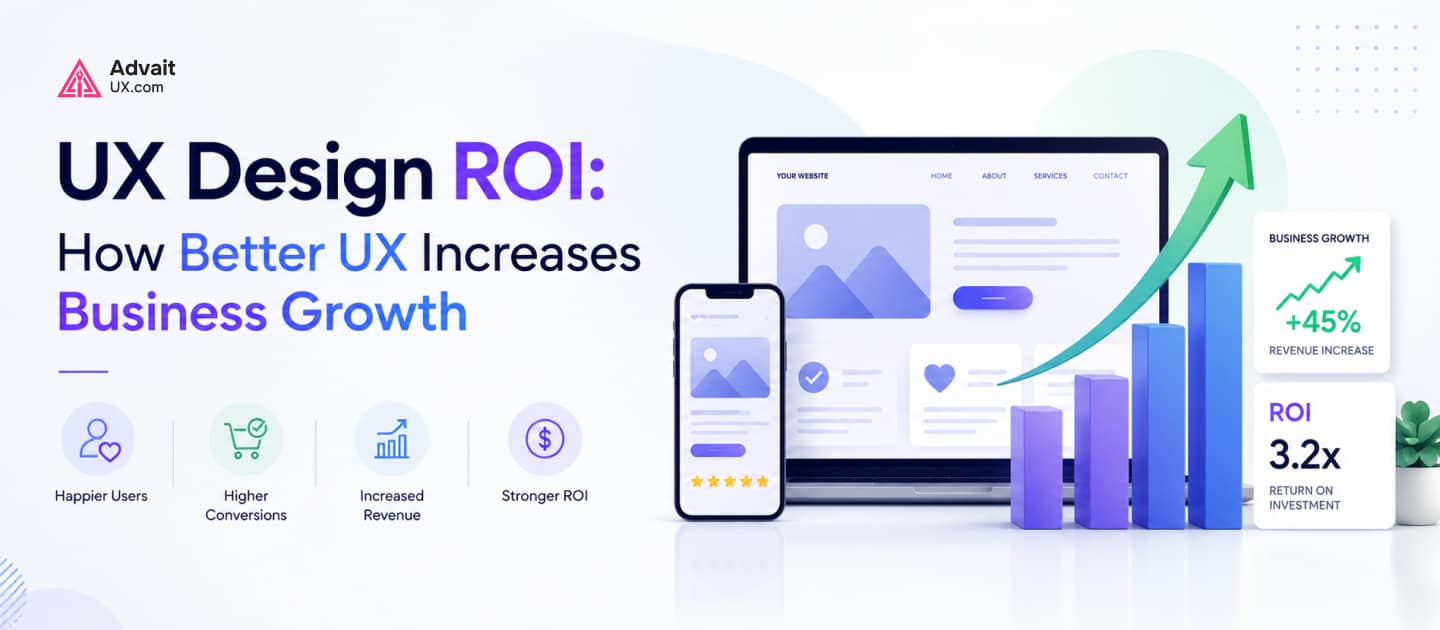
UX design ROI is the measurable business value a company gets back from the time and money it invests in improving user experience. It’s the same logic as any other investment: you put resources in, and you look at what comes out the other side — more signups, longer retention, fewer support tickets, higher average order value.
The tricky part is that UX doesn’t always sit in its own clean bucket on a P&L statement. It threads through marketing, product, engineering, and customer success. So businesses that measure UX ROI well tend to connect it to metrics that already matter to them: conversion rate, churn, activation rate, customer support costs, and revenue per user.
The mindset shift that matters most is this: UX should be treated as an investment, not an expense. An expense is something you pay to keep the lights on. An investment is something you expect to generate a return. Redesigning a confusing checkout flow isn’t overhead — if it lifts conversion by even two or three percentage points, it can pay for itself many times over within a single quarter.
Why UX Design Matters for Business Growth
Growth isn’t just a marketing function anymore. It’s a product function too, and UX sits right in the middle of it.
A better customer experience means users spend less mental effort figuring out how your product works and more time actually getting value from it. That translates into higher conversion rates, because every point of friction removed from a signup or purchase flow is a point where fewer people give up and leave.
It also drives deeper engagement. When a product feels intuitive, people come back to it without needing to be reminded. That familiarity builds brand trust — users associate ease with reliability, and reliability with credibility.
The flip side matters just as much. Reduced customer frustration isn’t just a soft, feel-good metric. Frustrated users generate support tickets, leave negative reviews, and churn quietly without ever telling you why. Good UX prevents that frustration before it starts, which protects both revenue and reputation at the same time.
How Better UX Design Increases ROI
1. Better UX Improves Conversion Rates
Conversion is often a friction problem disguised as a marketing problem. Companies pour budget into driving traffic, then lose a huge share of it at the exact moment users are ready to convert — a confusing form, a hidden pricing page, a signup flow that asks for too much too soon.
Removing friction usually means simplifying the journey: fewer required fields, clearer calls to action, and a visual hierarchy that tells users exactly what to do next. When usability improves, users don’t have to think as hard about what action to take — they just take it. That’s the entire game with conversion. Every extra decision point is a chance for someone to hesitate and leave.
2. UX Reduces Customer Churn
For SaaS companies, churn is the metric that quietly undermines everything else. You can have great acquisition numbers and still lose the business if users cancel faster than you can replace them.
A large share of churn traces back to users who never fully understood how to get value from the product. UX improvements — particularly around onboarding and in-app guidance — help close that gap. When users hit their “aha moment” faster, they’re far more likely to stick around long enough to become paying, loyal customers. SaaS teams that treat onboarding as a UX priority, not an afterthought, consistently see stronger retention curves.
3. Great UX Increases User Engagement
Engagement is a habit, and habits are built through ease. If a product requires effort every single time someone opens it, that effort becomes a small tax on usage — and over time, users stop paying it.
Intuitive interfaces reduce that tax to nearly zero. When actions feel obvious and navigation feels predictable, users engage more often and more deeply, because the product isn’t competing with their patience. This is especially visible in mobile apps, where a single confusing screen can be the difference between a five-minute session and someone closing the app for good.
4. UX Reduces Development Costs
This is the ROI angle most businesses underestimate. UX research done early — before a single line of code is written — prevents companies from building features nobody wants or interfaces nobody understands.
Fixing a bad decision after launch is dramatically more expensive than catching it during a prototype or usability test. Engineering time is one of the most costly resources a company has, and rebuilding a feature because users couldn’t use it the first time is a direct, avoidable loss. Investing in UX upfront isn’t just about better design — it’s about not paying twice for the same feature.
5. UX Builds Customer Trust
People form an opinion about whether they trust a product within seconds of using it, often before they’ve read a single word of marketing copy. A clean, professional, well-thought-out interface signals competence. A clunky one raises doubt, even if the underlying product is solid.
This matters even more in categories where trust is the entire sale — fintech, healthcare, and enterprise software, where users are handing over sensitive data or mission-critical workflows. In these spaces, UX isn’t a differentiator on the margins. It’s often the deciding factor in whether someone signs up at all.
Signs Poor UX Is Hurting Your Business
Some of the most damaging UX problems don’t come with obvious warning signs. They show up as patterns that get written off as “normal” until someone looks closely.
Watch for users leaving your site or app within seconds of arriving, low conversion rates on pages that should be performing well, and navigation that requires more than a couple of clicks to find something basic. Abandoned signup flows are another major signal — if people start creating an account and don’t finish, something in that flow is asking too much or explaining too little.
Recurring customer complaints about the same feature are a direct signal, even if support treats each ticket as a one-off. And a poor mobile experience deserves special attention, since a growing share of traffic for most businesses now comes from phones — a desktop-first product that feels broken on mobile is quietly losing a huge segment of potential customers.
UX Metrics Businesses Should Track
UX ROI becomes real once it’s tied to numbers a business already watches. The most useful ones to track include:
- Conversion rate — the percentage of users who complete a desired action, like signing up or purchasing.
- Retention rate — how many users continue to use the product over time.
- Churn rate — the rate at which customers stop using or paying for the product.
- Task completion rate — whether users can successfully complete key actions without giving up.
- Customer satisfaction — often measured through surveys like CSAT or NPS.
- Engagement metrics — session length, frequency of use, and feature adoption rates.
None of these metrics live exclusively in the “design” column of a spreadsheet. They’re business metrics that UX directly influences, which is exactly why UX deserves a seat at the strategy table rather than being treated as a downstream execution task.
UX ROI Examples Across Digital Products
The specifics of UX ROI shift depending on the type of product, but the underlying pattern holds everywhere.
For SaaS platforms, UX improvements to onboarding and dashboard clarity typically show up first in activation rate and, over a longer horizon, in reduced churn. A user who understands the product’s core value within their first session is far more likely to convert from trial to paid.
For mobile applications, UX ROI often shows up in session length and retention after the first week — a notoriously difficult metric to move, and one that’s highly sensitive to how intuitive the first few interactions feel.
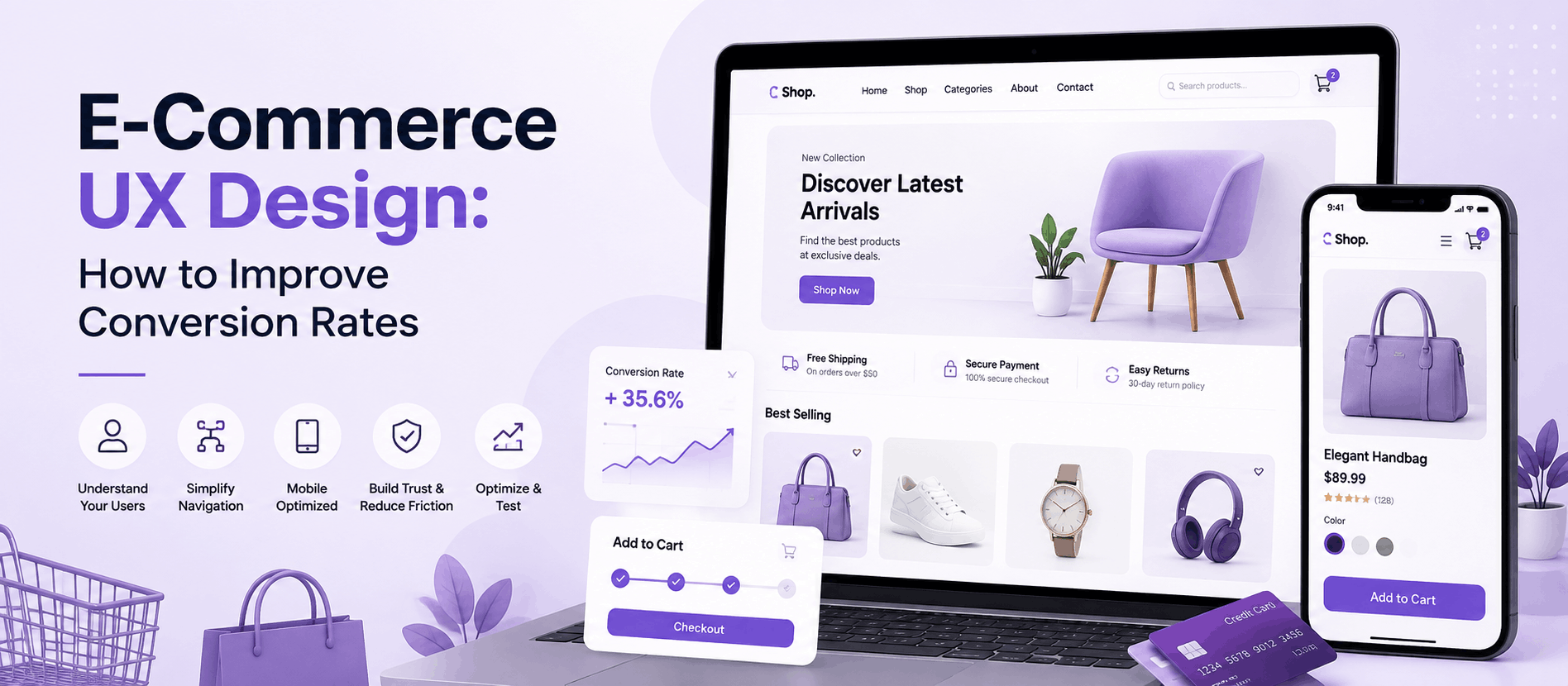
For eCommerce websites, ROI is usually visible almost immediately in cart abandonment rate and average order value. Small changes to checkout flow — fewer steps, clearer shipping information, visible trust signals — can move revenue within days.
For enterprise software, the payoff tends to be in adoption rate among employees and reduced training time. Enterprise tools are often powerful but overwhelming, and simplifying core workflows can dramatically cut the time it takes new users to become productive.
For fintech products, UX ROI is closely tied to trust and completion rate on sensitive actions like transfers or applications. Because the stakes feel higher to users, clarity and reassurance in the interface directly affect whether they follow through.
How Companies Can Improve UX ROI
Getting more value out of UX investment usually comes down to a handful of disciplined habits rather than one big redesign.
- Conduct UX audits to identify where users are getting stuck, confused, or dropping off before making any changes.
- Understand user behavior through analytics, session recordings, and direct user interviews rather than assumptions.
- Improve onboarding so new users reach their first meaningful success as quickly as possible.
- Simplify user flows by removing unnecessary steps, fields, and decision points.
- Test designs before development using prototypes, so costly mistakes get caught before engineering time is spent.
- Continuously optimize experiences rather than treating UX as a one-time project — user expectations and behavior shift over time, and the product should shift with them.
Why Investing in UX Gives Companies a Competitive Advantage
In most categories today, products compete on more than just features. Feature parity is common — what separates the products people actually choose to use is how the experience feels.
Companies that invest consistently in UX tend to build long-term growth that compounds, because retained customers cost less to keep than new ones cost to acquire. That retention builds customer loyalty, which shows up in referrals, reviews, and lower acquisition costs over time.
Better digital experiences also create stronger product adoption, particularly in categories where users have several similar options to choose from. When a product removes friction that competitors haven’t addressed, it becomes the path of least resistance — and in most markets, that’s exactly where users end up staying.
How AdvaitUX Helps Businesses Increase UX ROI
At AdvaitUX, we work with start-ups and growing businesses that want their product to do more than function — they want it to convert, retain, and scale. That means looking at UX not as a final polish step, but as a growth lever built into the product from the start.
Our work spans SaaS UX design for platforms looking to improve activation and reduce churn, product redesign for teams whose interface has outgrown its original design decisions, UX audit that pinpoint exactly where users are getting stuck, and mobile app UX design for teams whose growth increasingly depends on a smooth on-the-go experience.
The goal in every engagement is the same: fewer points of friction, clearer paths to value, and a product experience that supports the business metrics leadership actually cares about — conversions, engagement, and long-term retention.
Frequently Asked Questions
1. What is UX design ROI?
UX design ROI is the measurable business return generated by investments in improving user experience — typically reflected in higher conversion rates, better retention, lower churn, and reduced development costs from avoiding costly product mistakes.
2. How does UX design increase business growth?
Better UX removes friction from the customer journey, which means more users complete signups, purchases, and key actions. It also improves engagement and retention, both of which reduce the cost of acquiring and keeping customers over time — directly supporting sustainable growth.
3. Why should companies invest in UX design?
Because UX affects nearly every metric a business cares about: conversion, churn, customer satisfaction, and even development costs. Treating it as an investment rather than a cosmetic expense tends to produce measurable, compounding returns.
4. How can UX improve conversion rates?
By simplifying user journeys, reducing unnecessary steps, and making calls to action clear and obvious. Every point of friction removed from a signup, checkout, or key flow reduces the number of users who give up before converting.
5. How do you measure ROI from UX design?
By tracking business metrics before and after UX changes — conversion rate, retention rate, churn, task completion rate, and customer satisfaction scores. Connecting UX work to these existing metrics makes the return tangible rather than abstract.
6. Can better UX reduce customer churn?
Yes. A large share of churn comes from users who never fully understood how to use a product or never reached its core value. Improving onboarding and simplifying key workflows helps users succeed faster, which directly supports retention.
Conclusion
UX design isn’t a finishing touch — it’s a growth investment that shows up in the metrics businesses already track: conversion, retention, churn, and customer trust. Companies that treat user experience as core to their strategy, not a downstream design task, tend to build products people stick with, recommend, and keep paying for.
Creating user-focused products isn’t just about aesthetics or usability for its own sake. It’s about removing the friction that stands between a business and its growth targets. The companies that understand this — and act on it consistently — are the ones that turn better experiences into better, more durable business results.