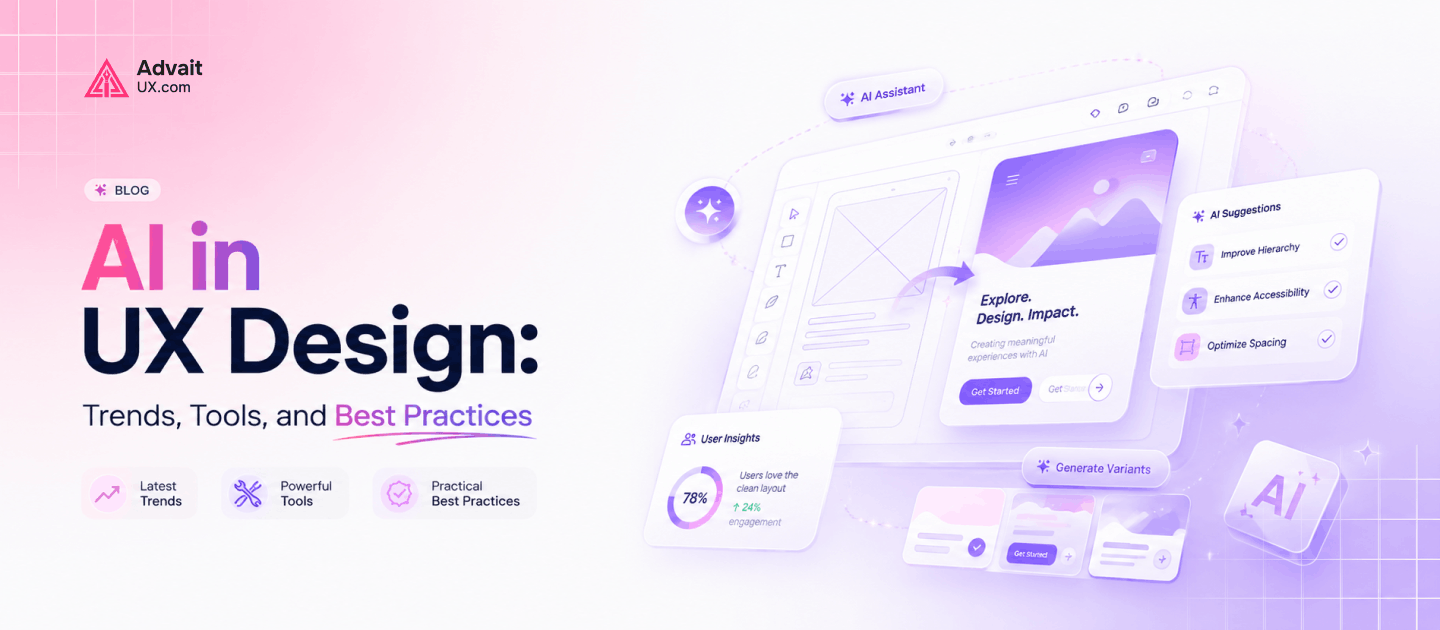
AI tools now sit inside nearly every design workflow, from early research to final handoff. and That shift has changed what a strong UX strategy actually requires. It has not changed why good design works in the first place.
This article looks at where AI genuinely helps UX teams, where it still falls short, and how to use it without losing the human judgment that makes products feel right.
How AI Actually Fits Into a Designer’s Day-to-Day Work
A UI/UX designer today spends less time on repetitive setup tasks than five years ago. AI can generate layout variations, suggest copy, and summarize user feedback in seconds. That frees up time for the harder problems AI still cannot solve.
The shift is less about replacing designers and more about changing where their effort goes. Research synthesis that once took days can now take hours, leaving more time for judgment calls.
Teams that treat AI as a research assistant, not a decision-maker, tend to get the most value from it.
From Prototyping to Personalization: Where AI Tools Help Most
Rapid prototyping is one of the clearest wins. A designer can generate several layout directions from a single prompt and test them quickly with stakeholders. This shortens the gap between an idea and something people can react to.
Personalization is another area seeing real progress. AI-driven UI solutions can adjust what a dashboard or app surfaces based on how someone actually uses it. Done well, this reduces clutter instead of adding more decisions for users to make.
AI is also useful for catching accessibility issues early, like low color contrast or missing labels, though it will not replace a full accessibility review.
AI and the Principles of UX Design Have Not Changed
The core principles of UX design still apply, regardless of how the interface gets built. Simplicity, consistency, clear feedback, and visual hierarchy remain just as important when AI is involved in the process. Tools change. Good judgment about what users need does not.
If anything, AI makes these principles more important, not less. It is easy to generate dozens of variations quickly, but speed without a clear strategy just produces more noise.
This is where UX design consulting earns its value, telling the difference between an AI suggestion that genuinely helps and one that just looks polished.
Psychology in UX Design Still Comes From Humans
Psychology in UX Design explains why certain layouts feel intuitive and others feel exhausting. AI can suggest patterns based on data, but it cannot fully explain why a user hesitated before clicking a button. That kind of insight still comes from direct observation.
Recognition over recall, progressive disclosure, and clear feedback loops are human-centered concepts. AI tools can help apply them faster, but someone still needs to understand the psychology behind them.
This is one reason usability testing with real people remains essential, even in AI-assisted workflows.
Where AI Falls Short: Judgment, Empathy, and Context
AI struggles with context that lives outside the data it was trained on. It does not know your specific users, their frustrations, or the business constraints behind a decision. A UX design audit conducted by people who understand that context will always catch things automated tools miss.
Empathy is another gap. AI can summarize survey responses, but it cannot sit with a frustrated user and notice the small details behind that frustration.
The most effective teams use AI to speed up analysis, then rely on human judgment for anything involving real user emotion or business risk.
Current AI-Driven UX Design Trends Worth Watching
Several UX design trends are shaping how teams work with AI right now. Predictive interfaces that anticipate a user’s next action are becoming more common in SaaS products. Voice and conversational interfaces are also expanding beyond simple chatbots into core navigation.
Generative design tools are speeding up early-stage exploration, and adaptive interfaces that adjust to user behavior are moving from experimental to mainstream. The Nielsen Norman Group tracks many of these patterns as they mature across the industry.
None of these trends matter without a clear strategy behind them. Adopting a trend because it is popular usually backfires.
Choosing Tools Without Losing Your Design System
The number of available AI design tools keeps growing, which creates its own kind of decision fatigue. A skilled UI/UX designer evaluates tools based on whether they fit an existing design system, not just on flashy demos. Consistency still matters more than novelty.
Tool sprawl is a real risk, since adding a new AI tool for every task can fragment a product’s look and feel over time.
It also helps to treat new tools as experiments, testing on a low-risk feature before rolling them out broadly.
Working With a UI/UX Design Agency in the AI Era
A good UI/UX design agency now blends AI fluency with the same research and strategy fundamentals that mattered before AI existed. The tools changed, but the underlying skill set has not.
True UX UI Mastery today means knowing when to use AI and when to step back from it. Some decisions still require slow, careful human thought.
Frequently Asked Questions
Will AI replace UX designers?
No. AI handles repetitive tasks well, but understanding user psychology and business context still requires human judgment.
What is the best way to start using AI in a design workflow?
Start with low-risk tasks like research synthesis or early prototyping, then expand gradually as the team builds confidence.
Does AI improve accessibility automatically?
It helps catch obvious issues like contrast problems, but a full accessibility review still needs human testing.
How do I know if my team needs outside UX design consulting?
If AI tools are creating more design variations than your team can evaluate strategically, outside expertise can help set priorities.
Conclusion
AI has changed how UX work gets done, but it has not changed why good design matters. The principles behind clear, trustworthy interfaces are the same ones that mattered before generative tools existed. What changes is how quickly teams can test and refine their thinking.
AdvaitUX applies this same balance across its client work, including products like, where thoughtful design still depends on human judgment as much as new tools. The agency pairs AI-assisted workflows with the strategy and research that make those tools actually useful.
If your team wants help thinking through where AI fits into your design process, AdvaitUX is a good place to start that conversation. Contact AdvaitUX through advaitux.com to talk through your product and current workflow.