Creating a great user experience goes far beyond attractive layouts and smooth interactions. At its core, psychology in UX Design deeply rooted — understanding how people think, feel, and behave while using digital products. When designers apply behavioral insights intentionally, interfaces become clearer, decisions become easier, and users feel more confident navigating a product.
In this article, we’ll look at how psychology affects UX design. We’ll discuss what makes an experience truly “good.” Also, we’ll see how businesses can use these ideas to create digital products that users love. If you’re designing or improving a product, this guide shows why human-centered design is effective and how to use it well.
What is the role of psychology in UX design?
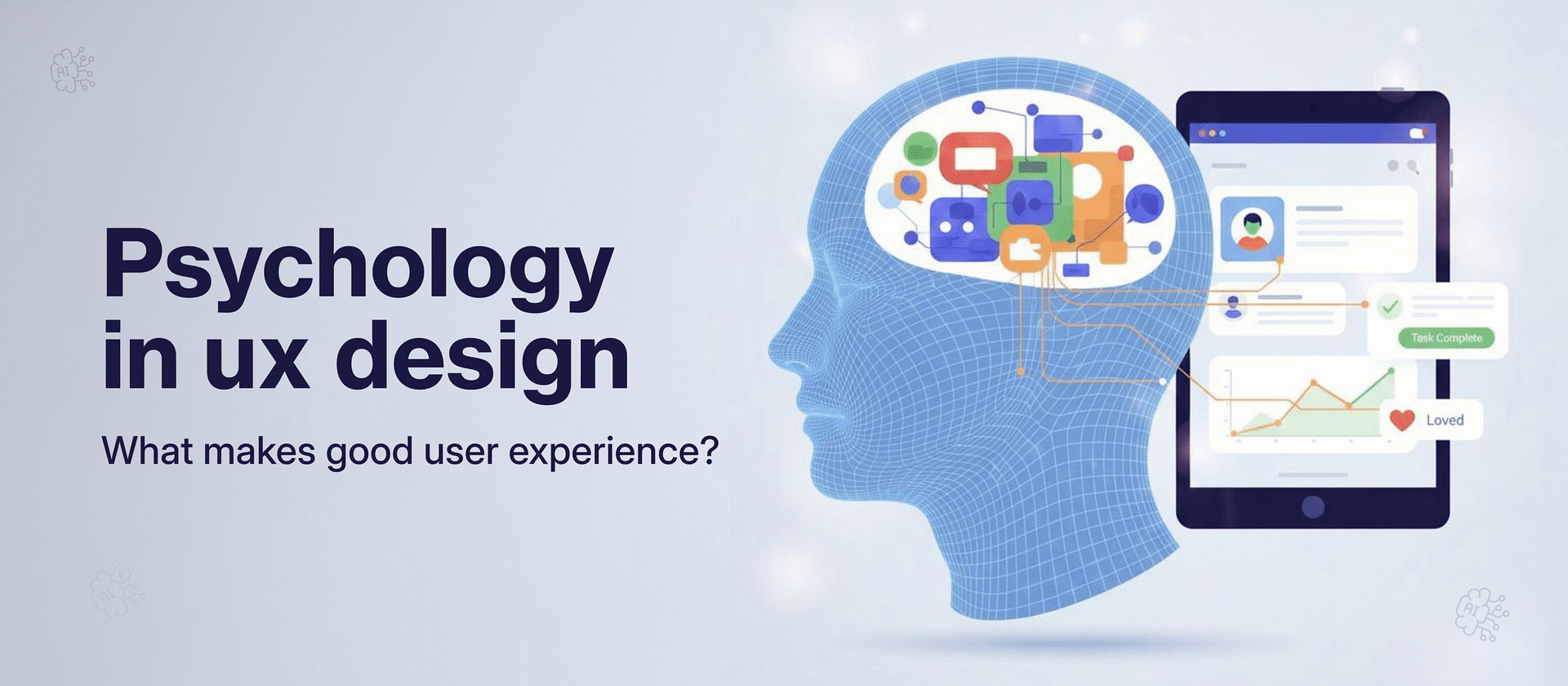
Psychology in UX design is about understanding how people think and behave. It helps us see how users interact with a product. Designers rely on psychological principles to answer questions like:
- What motivates users?
- Why do users click (or ignore) certain elements?
- Which visual patterns help people to process information faster?
- How do emotions shape decisions online?
When these insights guide design decisions, experiences feel intuitive instead of overwhelming. Users don’t need to “figure out” the interface — it simply works the way they expect.
Why Psychology Matters in Creating a Good User Experience
A good UX experience is not just about functionality. It’s about reducing friction, guiding behavior gently, and building trust.
Here’s why psychology is essential:
1. It Improves Usability
People rely on mental shortcuts. Designing with cognitive patterns makes your interface easy to understand quickly.
2. It Boosts User Satisfaction
Positive emotions are a major part of user experience. Psychological triggers like clarity, predictability, and positive feedback increase overall satisfaction.
3. It Helps Users Make Better Decisions
Users want clarity, not clutter. Understanding how people evaluate choices helps you guide them toward the right actions.
4. It Builds Trust
Trust is emotional. When design is transparent, reliable, and friendly, users feel safe — especially in digital spaces.
Key Psychological Principles That Make a Good UX Design
Below are the most impactful Psychology in UX Design should use.
1. Hick’s Law: Simplify Choices to Speed Up Decisions
Hick’s Law states that the more choices people have, the longer they take to decide.
In UX, too many buttons, forms, or menu items overwhelm users.
How to apply it:
- Use minimal, prioritized navigation.
- Hide advanced options under secondary menus.
- Break complex steps into smaller screens (like multi-step forms).
This makes your interface faster, cleaner, and easier for users.
2. Miller’s Law: Limit Cognitive Load
Miller’s Law suggests people can only hold about seven items in working memory.
This is why crowded pages lead to confusion.
How to apply it:
- Keep content digestible.
- Group similar elements together.
- Use short paragraphs, bullet points, and clean spacing.
The less users have to remember, the better they perform.
3. Gestalt Principles: Help Users See Patterns Instantly
Gestalt psychology explains how people visually organize information. Users naturally look for order, familiarity, and visual groups.
How to apply it:
- Use alignment, hierarchy, and proximity.
- Highlight key actions with consistent patterns.
- Create predictable layouts across devices.
Interfaces that feel structured are easier to trust.
4. The Zeigarnik Effect: Encourage Completion
People remember incomplete tasks more than completed ones. That’s why progress bars and checklists work so well.
How to apply it:
- Show progress indicators on forms.
- Use onboarding checklists.
- Offer visual “completion rewards.”
This motivates users to complete tasks without feeling pressured.
5. Emotional Design: Make Users Feel Something Positive
People don’t buy products; they buy feelings. A good UX uses emotional design to create trust, delight, and reassurance.
How to apply it:
- Use micro-animations for feedback.
- Write warm, friendly microcopy.
- Add visual cues that show success or progress.
Emotions shape how users remember your product — and whether they return.
What Does a Good User Experience Look Like?
Good UX is not defined by trends. It is defined by outcomes. Here are the signs of a strong user experience:
1. It Feels Effortless
Users shouldn’t have to think about where to click or what comes next. Every step should feel natural.
2. It Solves Real Problems
The experience should reduce effort, save time, or improve task success.
3. It Supports Clear Decision-Making
Good UX provides only what’s needed — no more, no less.
4. It Works for Real People
Accessibility is part of psychology. If your design works for users with different needs, it works for everyone.
5. It Builds Emotional Trust
A great product establishes a relationship. Clear communication, consistency, and reliability all shape trust.
How Psychology Improves UX Across the User Journey
1. First Impressions (0–5 seconds)
Users decide quickly whether to stay or leave. A clean, predictable interface creates instant confidence.
2. Interaction Phase
Psychological design guides users through tasks without frustration. Good spacing, clear instructions, and instant feedback keep users engaged.
3. Decision Stage
Behavioral science helps users choose confidently. Reducing friction leads to higher conversions and satisfaction.
4. Long-Term Engagement
Positive experiences create habit loops. When users enjoy the experience, they return naturally.
Where Can Psychology in UX Make the Biggest Impact?
Psychology in UX Design improves many areas, including:
- Onboarding flows
- Mobile app navigation
- E-commerce checkouts
- Dashboard interfaces
- Booking systems
- SaaS product experiences
- Customer support interactions
Wherever human decisions exist, psychology matters.
Who Benefits the Most From Psychological UX Design?
Psychology-driven UX benefits:
- Startups building user-friendly products
- Businesses improving conversions
- SaaS companies simplifying workflows
- E-commerce brands reducing cart abandonment
- Designers creating intuitive digital experiences
- Customers who want simple, stress-free interactions
Everyone wins when UX respects the human mind.
When should you apply psychological UX principles?
You should apply psychology throughout the entire design lifecycle:
- During research — to understand user motivations.
- During wireframing — to structure intuitive layouts.
- During visual design — to guide attention and emotion.
- During testing — to evaluate behavioral responses.
Early use of psychology saves time, money, and rework.
Real-World Perspective: How We Apply Psychology at AdvaitUX
At AdvaitUX, we use psychology-based design. This helps businesses create digital products that feel easy and valuable. Our approach involves:
- Studying real user behavior
- Identifying emotional friction points
- Designing consistent, predictable flows
- Simplifying data-heavy experiences
- Testing micro-interactions that improve confidence.
This isn’t a theory. It’s what we do daily on real projects in SaaS, eCommerce, healthcare, and enterprise dashboards.
Clients often tell us that after applying psychological UX principles, user engagement increases, onboarding becomes smoother, and support requests drop significantly.
Conclusion: What Truly Makes a Good User Experience?
A good user experience is psychological at its core. It understands how people think, what they expect, and how they decide.
By applying principles like Hick’s Law, Gestalt grouping, emotional design, and cognitive load reduction, you create digital experiences that feel natural instead of confusing.
To make your product convert, engage, and delight users, use psychology.
At AdvaitUX, we create with real-world experience, research insights, and a focus on human-centered design. If you’re building or improving a digital product and want expert guidance, reach out to our team. We’re always happy to help you create experiences users trust and love.