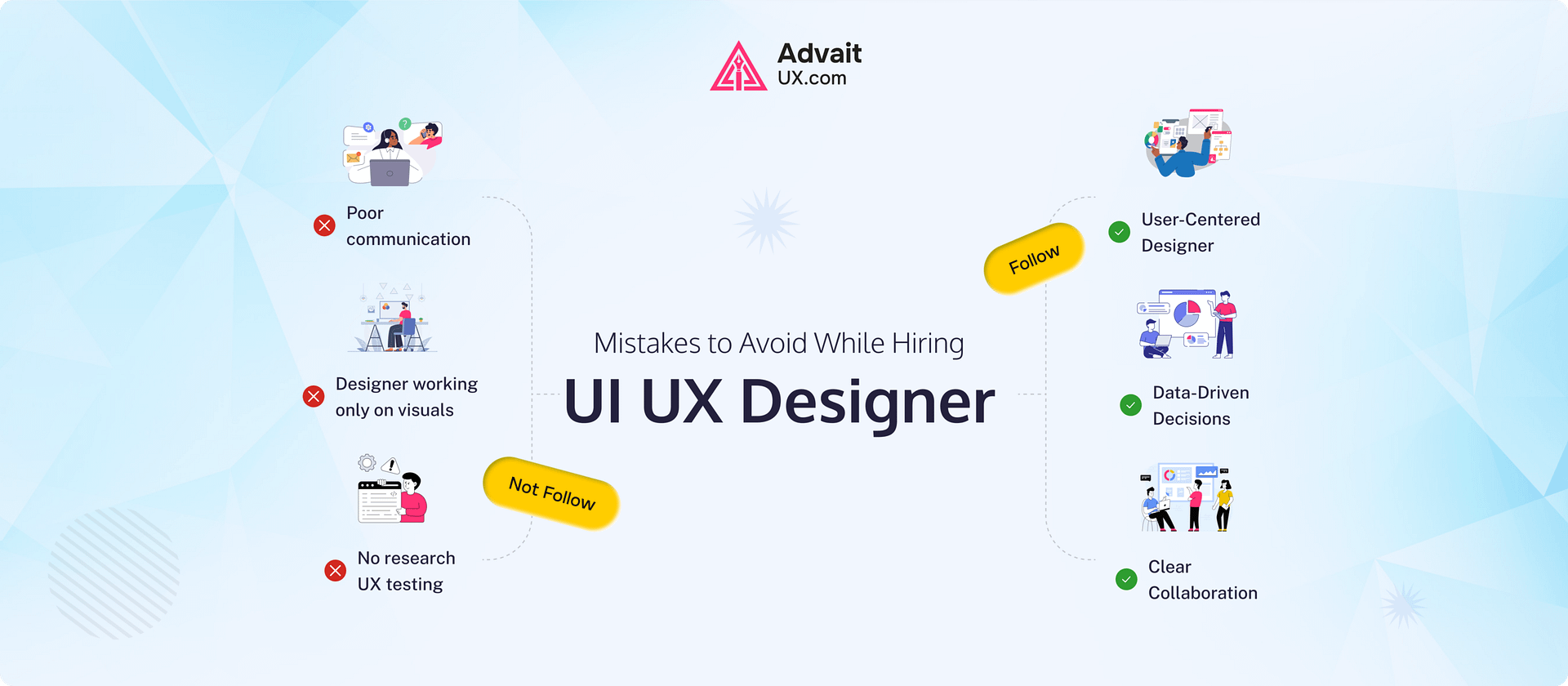
Hiring the right UI/UX designer can quietly transform your product.
The right person improves usability, boosts conversions, and makes your product feel effortless. The wrong hire creates confusion, endless revisions, and frustrated users.
Yet many companies still treat UX hiring like a visual design task. They check pretty screens instead of critical thinking, research skills, and problem-solving ability.
In reality, UX is deeply connected to behaviour, decision-making, and UX design psychology. It’s less about decoration and more about clarity.
If you’re hiring, this guide can help. It demonstrates how to avoid the problems we see with start-ups and growing teams at AdvaitUX. It will also indicate what you should seek for instead.
Why UX Hiring Deserves Serious Attention
Before diving into mistakes, it’s worth understanding the real UX design importance.
User experience affects:
- Customer satisfaction
- Conversion rates
- Retention
- Support costs
- Brand perception
A confusing product loses users fast. A smooth one builds loyalty without extra marketing.
So, hiring a UI/UX designer isn’t just filling a creative role. It involves making a strategic business choice.
Good UX saves money. Bad UX quietly burns it.
Hiring Only for Visual Skills
This is where most companies slip.
They select a UI/UX designer based on glossy mock-ups or trendy UI shots. The work looks modern, so they assume it’s effective.
But aesthetics alone doesn’t guarantee usability.
A product can look beautiful and still be frustrating to use.
UX is about simplifying decisions, organising information, and guiding users naturally. Visual design supports that — it doesn’t replace it.
When interviewing, ask candidates to explain:
- The problem they solved
- Why they made specific choices
- What changed after testing
If they only talk about colours and typography, you’re likely hiring a decorator, not a strategist.
Skipping Research Experience
Great design begins with understanding people.
Jumping straight into wireframes without discussing research is a red flag.
Strong UX relies on evidence, not assumptions.
Designers should be comfortable:
- Talking to users
- Conducting interviews
- Running usability tests
- Reviewing analytics
- Studying behaviour patterns
They focus on UX design psychology. This helps them create designs that reflect real behaviour. It focuses on how people act, not our guesses.
In many redesign projects we handle, the biggest issues come from one root cause: no research was done.
A few early conversations could have prevented months of rework.
Treating UX Like a One-Person Task
Some companies expect one hire to do everything perfectly.
Research, strategy, UI, testing, documentation, and sometimes even development support.
That’s unrealistic.
UX works best as collaboration.
UI/UX Designers need regular input from:
- Product managers
- Developers
- Stakeholders
- Marketing teams
When hiring, look for communication skills as much as technical skills.
A strong UI/UX designer asks questions, challenges assumptions, and explains decisions clearly.
Because UX is a team sport.
Ignoring the UI/UX Designer’s Process
A polished portfolio can hide weak thinking.
Pretty screens don’t show how decisions were made.
That’s why process matters.
Ask candidates how they approach a new feature from scratch. Listen carefully.
They should start by understanding users. Then, they can explore options, prototype quickly, and test ideas.
If they only mention “designing screens,” they’re skipping the most important steps.
A reliable process ensures consistent results — especially when deadlines are tight.
Bringing UX in Too Late
Many teams hire design help after development has already started.
By then, major decisions are locked.
So UX becomes cosmetic instead of strategic.
This completely undermines the value of design.
When UI/UX designers are involved early, they prevent problems before code is written. Fixing a sketch takes minutes. Fixing developed features takes weeks.
Early involvement reduces risk dramatically.
That’s where the real ROI of UX shows up.
Choosing Cheap Over Capable
Budget pressures are real, especially for start-ups.
But low-cost design often leads to high-cost fixes later.
Poor usability causes:
- Lower conversions
- More support tickets
- Frequent redesigns
- Slower development
These costs quickly outweigh initial savings.
Instead of choosing purely on price, consider long-term value. Investing in skilled talent or a trusted UI/UX service often saves more money in the long run.
Good UX pays for itself.
Overlooking Business Thinking
UX isn’t just empathy for users. It’s alignment with business goals too.
A capable UI/UX Designer should understand metrics and outcomes.
They should ask:
- What’s the primary goal of this feature?
- What action matters most?
- Where are users dropping off?
If design choices don’t connect to measurable results, the work might look good. But it won’t help the business grow.
The best designers balance user needs and business objectives naturally.
Expecting Instant Perfection
Design isn’t a one-shot activity.
It improves through iteration.
If you expect flawless solutions immediately, you’ll be disappointed.
Strong designers test ideas early, gather feedback, and refine continuously. They’re comfortable learning and adjusting.
Iteration is not a weakness. This is how good goods are created.
Perfection comes from improvement, not guesswork.
Questions You Should Always Ask Before Hiring
Before making a final decision, have deeper conversations.
Portfolios show outcomes. Questions reveal thinking.
Ask them to describe a real project — especially the messy parts.
What didn’t work initially? What changed after testing? How did they measure success?
Experienced UI/UX designers talk openly about mistakes and learnings. That honesty shows maturity.
You can also give a simple scenario from your own product.
For example: “Our signup conversion is low. How would you approach fixing it?”
A strong candidate will ask about users, data, and behaviour first. They’ll propose research and experiments.
A weaker one will jump straight into visual tweaks.
That difference tells you everything.
If all this seems overwhelming, a professional UI/UX service or expert partner can help. They can guide you to make better choices and avoid expensive hiring errors.
Final Thoughts: Hire Thinkers, Not Designers
After years of working with founders and product teams, one lesson always stands out:
The best hires aren’t the most artistic. They’re the most thoughtful.
They understand people. They question assumptions. They confirm ideas. They connect design to results.
That’s where real impact comes from.
Looking for help with hiring? Want to improve your product experience or create a strong UX strategy? AdvaitUX is here for you. Our team offers research, design, and consultation support. We focus on startups and growing businesses.
Feel free to explore our UX/UI services or reach out for a strategy discussion. We’re happy to guide you toward smarter design decisions.
Because great UX isn’t about making things look better.
It’s about making things work better — for both users and your business.