Some products work. Fewer products feel effortless. That difference almost always comes down to UX Research.
You can have strong features, clean visuals, and solid tech. Still, you might see drop-offs and confused users. Meanwhile, another product with simpler functionality wins hearts because it feels easier.
What separates the two?
Research.
At AdvaitUX, we’ve learned one clear truth over the years: Good UX research makes ideas better. It turns good ideas into great results. It eliminates guesswork and replaces it with clarity.
Let’s break down how it works — and how you can apply it.
Why UX Research Matters More Than You Think
Many teams treat UX research as optional.
Something “nice to have” if there’s time.
But skipping UX research is like building a house without checking the ground first.
You might get lucky. Or you might rebuild everything later.
Strong UX design decisions come from evidence:
- Who the users are
- What they struggle with
- Why they behave a certain way
- What motivates action
Without this, you’re designing based on assumptions.
And assumptions are expensive.
Understanding Real User Behaviour First
Before any wireframes or screens, great products start with listening.
Talking to users sounds simple, but it changes everything.
You discover:
- Hidden frustrations
- Workarounds people created
- Needs they never clearly expressed
- Features they actually don’t care about
This is where UX cognitive psychology plays a role.
People don’t always behave logically. They get distracted, impatient, and overwhelmed easily. Research helps you design for real human behaviour — not ideal scenarios.
For example, users rarely read instructions. So instead of adding tooltips, you simplify flows.
That insight only comes from observation.
Turning Insights into Strategy
Research without direction is just data.
The next step is translating insights into a clear UI Strategy.
This is where you define:
- Priority users
- Core problems
- Key journeys
- Success metrics
Strategy aligns everyone.
Instead of debating opinions, teams focus on what users actually need.
At AdvaitUX, this step often saves clients from building unnecessary features. Sometimes the best decision is removing complexity, not adding more.
Clarity beats volume.
Exploring Ideas Before Building
Once the strategy is clear, ideas come faster.
But instead of jumping into polished UI, smart teams explore options cheaply.
Sketches. Flows. Rough wireframes.
Low-fidelity work encourages experimentation.
You can test five ideas in a day instead of perfecting one for weeks.
Research gives you direction. Exploration gives you flexibility.
Together, they prevent costly mistakes later.
Designing with Evidence, Not Opinion
Here’s where research truly shines.
Every design decision now has a reason.
Buttons aren’t placed randomly. Navigation isn’t guesswork. Content isn’t cluttered.
Each element supports a specific user goal.
This makes UX design feel intentional instead of decorative.
When designers say, “We chose this layout,” it shows users had trouble finding checkout. This is evidence-based design.
It is significantly more effective than saying, “It looks better this way.”
Evidence builds confidence — for both teams and stakeholders.
Testing Early to Catch Real Problems
Even great ideas fail sometimes.
That’s normal.
What matters is catching issues early.
Usability testing allows you to observe how real consumers interact with your product.
And it’s always eye-opening.
You’ll notice:
- Buttons people ignore
- Steps they skip
- Confusion at unexpected moments
Small friction points become obvious quickly.
Testing even simple prototypes can reveal 70–80% of usability problems.
Fixing those early is dramatically cheaper than fixing them after launch.
Launching with Confidence
Products built on research launch differently.
There’s less anxiety.
Fewer surprises.
Fewer emergency fixes.
Because decisions were validated along the way.
When teams follow research-backed processes, they don’t rely on hope. They rely on data.
This reduces risk and speeds up development.
Engineers build what users actually need. Designers focus on clarity instead of rework.
Everyone moves faster.
Improving Continuously After Release
UX research doesn’t stop at launch.
In fact, some of the best insights come afterward.
Real-world usage shows:
- Drop-off points
- Popular features
- Unexpected behaviours
- Support complaints
These signals guide improvements.
Great user experience is never static. It evolves.
Small, consistent updates often outperform large redesigns.
Continuous learning keeps products competitive.
What This Looks Like in Real Projects
Here’s a simple example from our agency work.
A SaaS start-up came to AdvaitUX with low onboarding completion.
They assumed the issue was visual design.
After research, we discovered something different.
Users weren’t confused by UI. They were overwhelmed by too many steps.
We made the flow simpler. We cut out extra inputs. This made things easier. We used ideas from UX cognitive psychology.
Completion rates improved significantly — without major visual changes.
The problem wasn’t design polish. It was understanding behaviour.
That’s the power of research.
Common Signs You’re Skipping Research
If any of these feel familiar, research may be missing:
- Frequent redesigns
- Stakeholder debates based on opinions
- Features nobody uses
- High drop-offs
- “It looks good but doesn’t convert”
These are usually symptoms of guessing.
Research replaces guessing with clarity.
A Simple Research Framework You Can Follow
You don’t need complex tools to start.
A basic approach works well:
- Talk to users
- Observe behaviour
- Identify patterns
- Define priorities
- Prototype quickly
- Test and refine
Repeat.
This loop keeps improving your user experience over time.
Consistency beats complexity.
Final Thoughts: Great Products Start with Listening
After working on dozens of digital products, one lesson stands out clearly:
The best designs don’t come from inspiration.
They come from understanding.
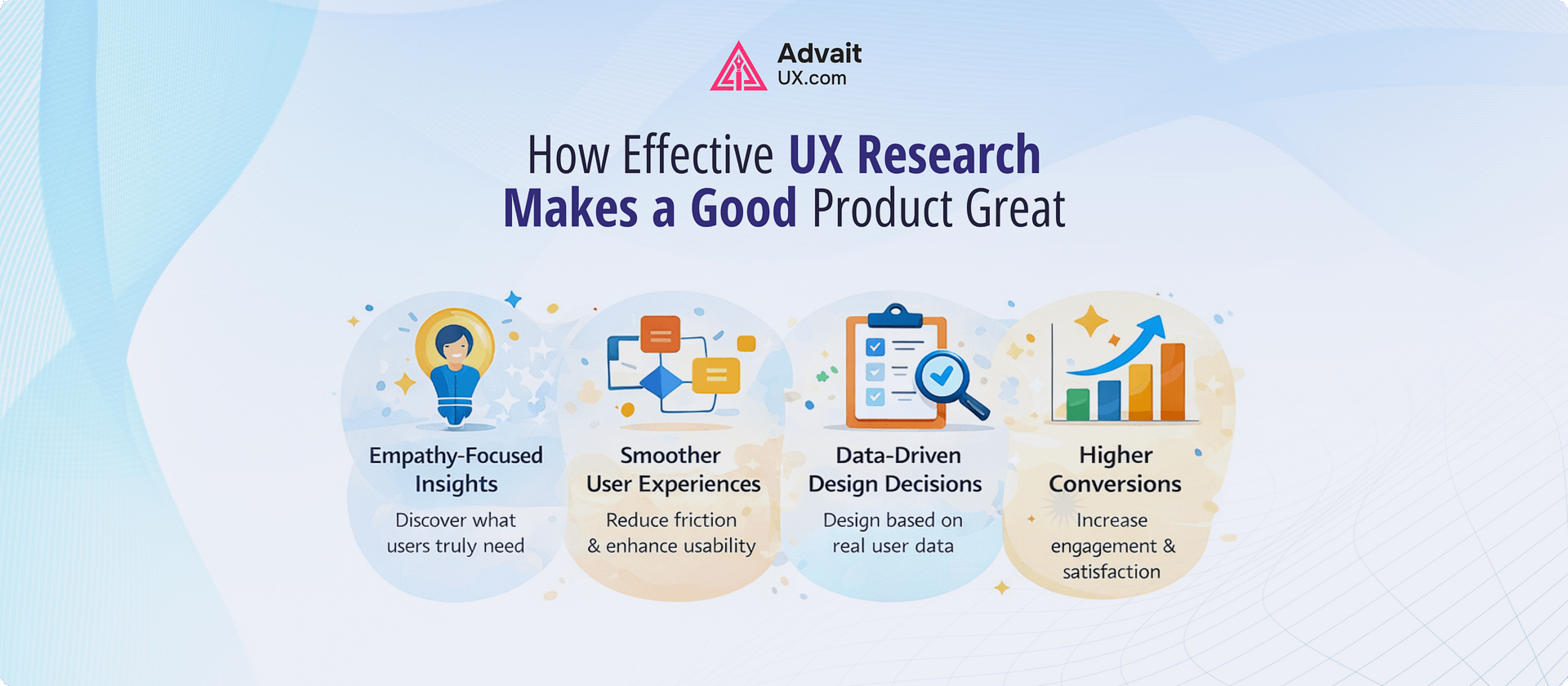
Effective UX research builds empathy. Empathy builds clarity. Clarity builds great products.
If you’re investing in UX design, don’t treat research as optional. It’s the foundation.
At AdvaitUX, we help Start-ups and growing teams. We provide UX research, strategy, and design systems that create measurable results. We focus on a user-first and data-driven approach. First, we define your UI strategy. Then, we optimise your current products.
If you want expert help or a new view on your product, check out our UX/UI services or Contact us for a consultation.
Because when you truly understand your users, good products don’t just work.
They become unforgettable.