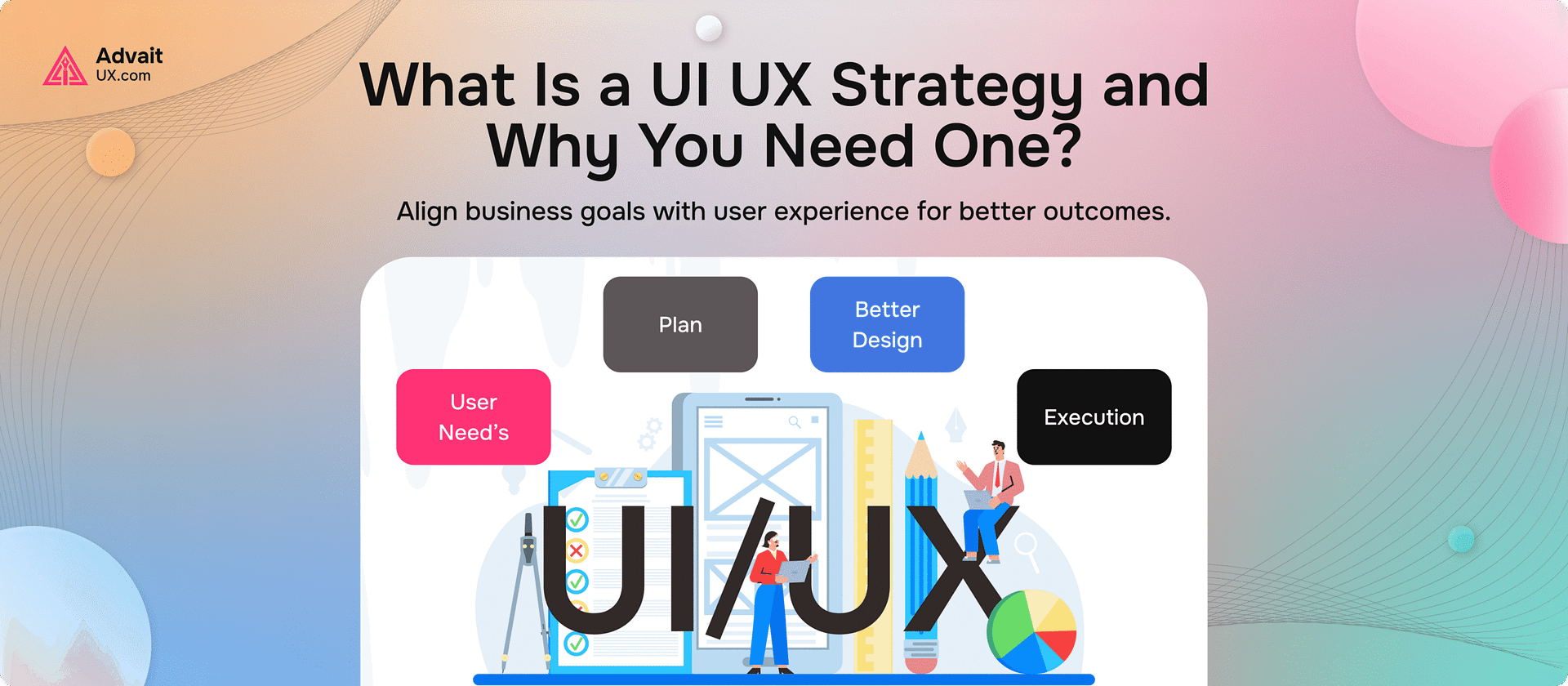
Short answer: A UI/UX strategy connects user research, business goals, and design decisions into one coherent plan. Without it, design becomes reactive (one feature at a time). With it, every screen and interaction reinforces the same outcome — adoption, conversion, or retention. (Further reading: NN/g — UX strategy.)
📅 Last updated: June 6, 2026
⏱ 5 min read · 1,154 words
This article is part of our guide on what UI/UX design is — the complete guide.
Designing digital products without a clear UX strategy is like building a house without plans. You need a blueprint to guide your work. You need a blueprint to guide you. You need a blueprint to succeed. You need a guide to create something strong. You might find something that works. But it will probably be inefficient. It could also be fragile and costly to fix later. A clear UI UX strategy is now essential for modern businesses, not just optional.
As a UX/UI agency working with start-ups, enterprises, and SaaS teams, we see a clear trend. Products with a strong UX strategy perform better. They outshine those based on assumptions, trends, or just appearances. This article explains what a UI UX strategy is, how it works, and why it’s crucial for long-term business success.
What is UX design in simple terms?
UX design is all about how users interact with a product. It looks at how easy it is to use, how intuitive it feels, and how well it helps them reach their goals.
It goes far beyond screens and layouts. UX design considers:
- User behaviour and expectations
- Task flows and decision-making
- Accessibility and usability
- Emotional response and trust
To get UX design, remember this: every online interaction changes how users see your brand.
What is a UI/UX strategy?
A UI UX strategy is a clear plan. It connects user needs with business goals before design starts.
It defines:
- Who are your users?
- What problems are you solving?
- How success is measured.
- Why are certain design decisions made?
Skip the visuals at first. Strategy makes sure research, psychology, usability, and business goals guide each design phase.
Why businesses need a UX strategy
Many products fail not because of poor ideas, but because of poor experiences.
Without a UX strategy, teams often face:
- Feature overload
- Confusing navigation
- Low adoption rates
- Costly redesigns
A strong UX strategy reduces risk. It ensures teams build the right product before building it right.
Who is involved in UX strategy?
UX strategy is collaborative by nature. It typically involves:
- UX strategists and researchers
- UI designers
- Product managers
- Business stakeholders
- Developers (early-stage input)
A professional UI/UX design agency helps with this teamwork. It turns business goals into user-focused design choices.
At AdvaitUX, we design UX strategy workshops to align teams early. This approach saves time and costs later in development.
The Core UX Phases Explained
A UI UX strategy is executed through clearly defined UX phases. Each phase builds on the previous one and serves a specific purpose.
1. Research and Discovery
This phase focuses on understanding users and context.
Activities often include:
- Stakeholder interviews
- User interviews and surveys
- Market and competitor analysis
Research reveals real problems—not assumptions. It forms the foundation for all design decisions that follow.
2. UX Audit and Evaluation
For existing products, this phase may include an audit of the UX design process.
A UX audit evaluates:
- Usability issues
- Accessibility gaps
- Conversion friction
- Inconsistent interactions
Audits show businesses what works and what’s broken. They also highlight areas needing change. Best of all, they don’t need starting over.
3. Defining the UX Strategy
Insights from research and audits are synthesised into a clear strategy.
This includes:
- User personas
- Journey maps
- Experience principles
- Prioritized opportunities
This stage explains why each design choice is important. It shows how these choices help both users and business results.
4. Information Architecture and Flows
Structure comes next.
Designers organise content and define how users move through the product. Clear information architecture reduces cognitive load and makes complex systems easier to use.
This is one of the most overlooked stages of UX design, yet it has a massive impact on usability and scalability.
5. Interaction Design and Wireframing
Wireframes visualise the strategy without visual distractions.
They focus on:
- Layout logic
- Interaction behavior
- Content hierarchy
This phase helps teams test ideas fast. They can make changes before starting UI design or development.
6. UI Design and Design Systems
Once UX is validated, UI design brings the experience to life.
UI design applies:
- Brand identity
- Visual hierarchy
- Consistent components
When UX and UI collaborate, the product feels intuitive and trustworthy. It’s never just decorative for looks.
7. Usability Testing and Validation
Testing ensures the strategy works in the real world.
Usability testing helps teams:
- Identify friction points.
- Confirm assumptions
- Improve task success rates.
This phase completes the feedback loop. It makes sure the experience changes based on how users actually behave.
The Role of UX Psychology in Strategy
5
A strong UX strategy is grounded in ux psychology.
It considers how users:
- Process information
- Make decisions
- React emotionally to interfaces.
Cognitive load, familiarity, and feedback loops matter for designers. They help make experiences feel easy. They keep things from feeling forced.
Where UX strategy is applied
UX strategy applies across all digital touchpoints, including:
- Websites and mobile apps
- SaaS and enterprise platforms
- E-commerce systems
- Internal tools and dashboards
Any product with users benefits from intentional UX planning.
How businesses enjoy UX strategies
From agency experience, companies with a clear UX strategy consistently see:
- Higher engagement and conversion rates.
- Faster user onboarding
- Reduced support and rework.
- Stronger product-market fit
UX strategy makes design a measurable business asset, not just a subjective cost.
Why work with a UX/UI strategy agency?
Internal teams often lack the time or objectivity to define UX strategy properly.
A specialised agency brings:
- Cross-industry experience
- Proven research frameworks
- Unbiased insights
- Scalable design systems
At AdvaitUX, we view UX strategy as a long-term investment. It balances usability and psychology. We also focus on business goals. Our approach is ethical and user-first.
Final Thoughts: UX Strategy Is the Difference Between Guessing and Knowing
A UI UX strategy gives teams clarity, confidence, and direction. It replaces guesswork with insight and transforms design into a strategic advantage.
Investing in UX strategy early is important. It helps whether you’re launching a new product or improving one. This leads to better decisions, stronger experiences, and lasting growth.
💡 Working on your own product? Start with a structured UX audit to surface the highest-impact friction in 1–3 weeks, or get in touch to scope a project with our Austin-based team.
About the Author
Darshan Italiya is the Founder & UX Lead at AdvaitUX, a UI/UX design agency based in Austin, TX. A Google-certified UI designer with 7+ years of experience and 70+ shipped product designs, he writes about user-centered design, UX strategy, and conversion-focused interfaces. Learn more about AdvaitUX or connect on LinkedIn.