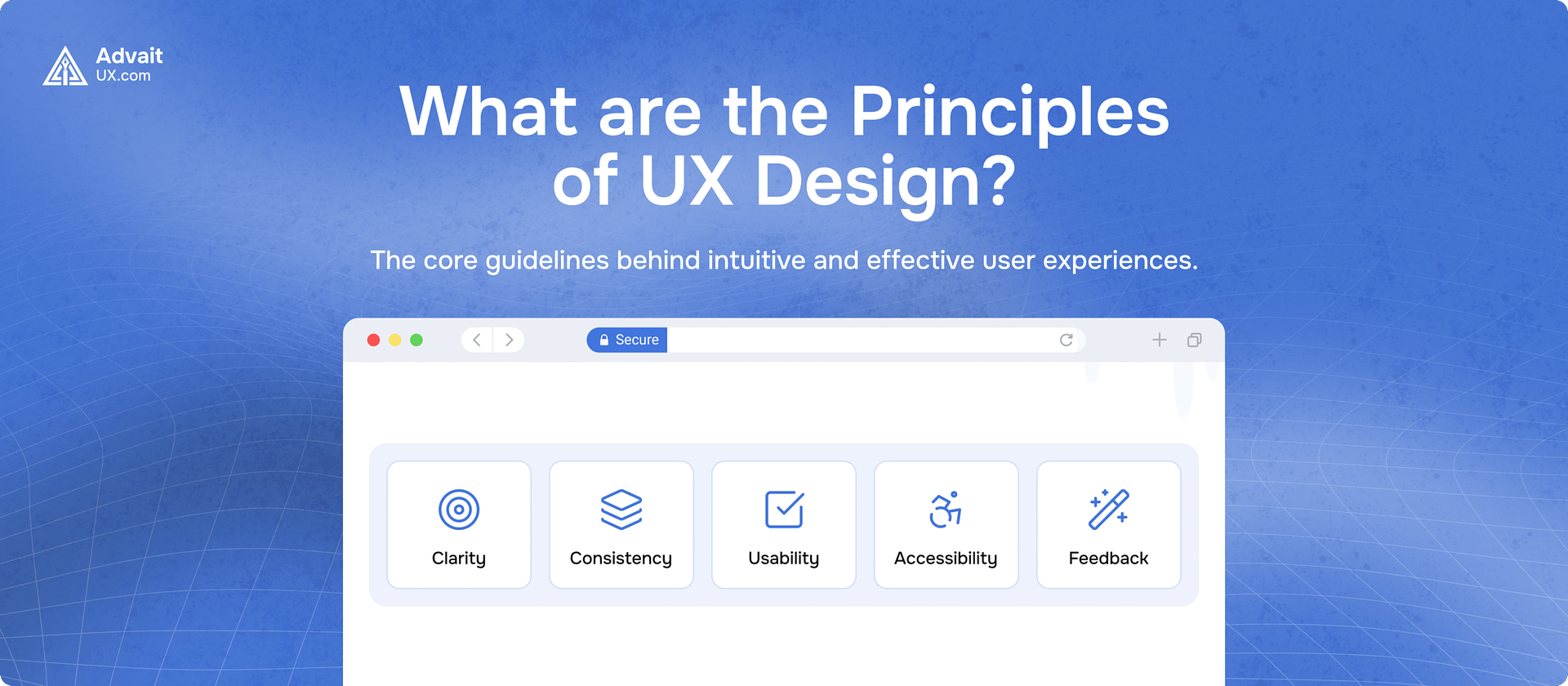
Short answer: The core UX design principles are user-centricity, consistency, visual hierarchy, accessibility, feedback, and simplicity. Unlike visual trends, these principles don’t change with fashion — they’re durable rules that reduce usability errors, speed up tasks, and build user trust across any platform. (See also: Interaction Design Foundation — UX design principles.)
📅 Last updated: June 6, 2026
⏱ 7 min read · 1,587 words
User experience (UX) design has become one of the most important aspects of building successful digital products. Whether it’s a website, mobile app, or software platform, users expect experiences that feel simple, intuitive, and helpful. When a product is easy to use, people trust it more. When it feels confusing or frustrating, they leave without a second thought.
Understanding the principles of UX design helps teams create products that truly work for users. These principles guide how experiences are planned, designed, tested, and improved. They are useful not only for a UX Designer, but also for founders, developers, and anyone involved in digital decision-making. In this article, we’ll explain what UX principles are, why they matter, who should use them, and how they are applied in real-world projects.
Go deeper: see the best practices and key principles of UX design, how typography shapes UI design, and the role of information architecture in modern web design. Want these principles applied to your product? Explore our UI/UX design services.
What Are UX Design Principles?
principles of UX design principles are foundational guidelines that help designers create meaningful and usable experiences. They focus on how users think, behave, and interact with digital interfaces. Instead of guessing what users want, these principles rely on observation, testing, and real human behavior.
Unlike visual trends, principles of UX design do not change often. They are rooted in psychology and usability best practices. When applied correctly, they help reduce confusion, improve task completion, and create products that feel natural to use. Good UX design is not about decoration—it is about solving problems clearly and effectively.
Why Are UX Design Principles Important?
People have limited patience when using digital products. If something feels difficult or unclear, users rarely give it a second chance. Principles of UX help remove friction and guide users smoothly toward their goals.
From a business point of view, strong principles of UX design improves engagement, conversions, and customer satisfaction. From a user’s perspective, it saves time and effort. This is why principles of UX design are at the core of successful ux&ui design and long-term digital growth.
Who Should Use UX Design Principles?
Principles of UX are not only for designers. They are valuable for anyone involved in building or managing digital products. Product managers use them to define features. Developers use them to create intuitive interactions. Business owners use them to improve customer experiences.
Even teams without a dedicated Good UX role benefit from understanding these principles. When everyone shares a user-centered mindset, decisions become clearer and more aligned with real needs.
When Should UX Principles Be Applied?
UX principles should be applied as early as possible. The best time to think about UX is during planning, not after development is complete. Applying Principles of UX early helps avoid costly redesigns and usability issues later.
They are especially useful during user research, wireframing, prototyping, and usability testing. However, UX does not stop after launch. Ongoing improvements based on feedback are just as important.
Principle 1: Design for Real Users
The most important principle of UX design is empathy. Every design decision should be based on user needs, not assumptions or personal preferences. Designers must understand who the users are, what they want to achieve, and what problems they face.
This is where UX Research becomes essential. Research methods like interviews, surveys, and usability testing provide real insights. Without research, design decisions are based on guesswork, which often leads to poor user experiences.
Principle 2: Keep the Experience Simple and Clear
Simplicity is one of the strongest Principles of UX. Users should understand how to use a product without instructions. Clear navigation, familiar patterns, and straightforward language help users move confidently through an interface.
Creativity has its place, but clarity should always come first. When users don’t have to think about how something works, they can focus on what they want to achieve. That is the goal of good UX.
Principle 3: Maintain Consistency
Consistency helps users feel comfortable and in control. When buttons, layouts, and interactions behave the same way throughout a product, users learn faster and make fewer mistakes.
Inconsistent design forces users to relearn things repeatedly, which increases frustration. Consistency is especially important in large ux&ui systems, where multiple screens and features must feel connected.
Principle 4: Create Clear Visual Hierarchy
Visual hierarchy helps users understand what is important. Not all information should compete for attention at the same level. Headings, spacing, contrast, and alignment guide users through content naturally.
A strong hierarchy makes interfaces easier to scan and reduces cognitive effort. Users can quickly find what they need without feeling overwhelmed.
Principle 5: Provide Feedback for Every Action
Users need feedback to feel confident. When they click a button, submit a form, or complete a task, the system should respond clearly. Feedback reassures users that their action was successful or explains what went wrong.
Simple cues like loading indicators, success messages, and helpful error text can significantly improve the user experience. Silence or unclear responses often lead to confusion and doubt.
Principle 6: Design with Accessibility in Mind
Accessibility is a key part of Principles of UX. A good experience should work for people of all abilities. This includes users with visual, motor, or cognitive challenges.
Accessible design uses readable text, sufficient color contrast, clear focus states, and keyboard-friendly navigation. When accessibility is considered from the start, products become more inclusive and usable for everyone.
Principle 7: Reduce Cognitive Load
Cognitive load refers to how much mental effort a user needs to complete a task. Good UX design minimizes this effort by breaking tasks into steps, removing unnecessary information, and using familiar patterns.
When users don’t have to remember too much or make complex decisions, they complete tasks faster and with fewer errors. Reducing cognitive load leads to smoother and more enjoyable experiences.
Principle 8: Prevent Errors Before They Occur
The best Principles of UX prevents problems before they happen. Clear instructions, logical flows, and smart defaults guide users toward the right actions.
When errors do occur, messages should be friendly and helpful. Instead of blaming users, good UX explains what went wrong and how to fix it. This builds trust and reduces frustration.
Principle 9: Test and Improve Continuously
UX design is an ongoing process. No design is perfect on the first attempt. Usability testing helps teams understand what works and what doesn’t.
Testing can be done with prototypes, early designs, or live products. Regular testing ensures that products stay aligned with real user needs as expectations and behaviors change.
How UX Principles Support SEO and Voice Search
Principles of UX also help improve search performance. Clear structure and readable content make it easier for search engines to understand pages. Short, direct explanations work well for voice assistants and answer engines.
When UX and content design work together, products perform better for both users and search algorithms.
Real-World UX Experience from AdvaitUX
At AdvaitUX, we often work with products that look visually appealing but struggle with usability. In many cases, the core issue is not design effort, but missing UX fundamentals.
When UX principles are applied early—through research, testing, and structured design—products become easier to use and scale more effectively. Our experience shows that UX principles are practical tools that directly impact product success.
Final Thoughts
Principles of UX principles exist to make digital experiences better for people. They help teams design products that feel intuitive, accessible, and trustworthy. For businesses, they reduce risk and improve outcomes. For users, they make everyday interactions simpler and more enjoyable.
In today’s competitive digital environment, strong UX is no longer optional—it is essential.
How AdvaitUX Can Help
AdvaitUX helps businesses apply UX principles in real, measurable ways. We provide UX research, UX and UI design, usability testing, and product strategy services tailored to real user needs.
Frequently Asked Questions
What are the core principles of UX design?
The core UX design principles include user-centricity, consistency, hierarchy, accessibility, feedback, and simplicity. Together they ensure a product is intuitive, usable, and meets real user needs rather than just looking good.
Why do UX design principles matter?
Principles give teams a shared, durable framework for decisions. Unlike visual trends, they do not change with fashion — applying them consistently reduces usability errors, speeds up tasks, and builds user trust.
How do you apply UX principles in a real project?
Start with user research, then use the principles to guide information architecture, wireframes, and interface decisions. Validate with usability testing and iterate, so each principle is checked against real user behavior.
💡 Working on your own product? Start with a structured UX audit to surface the highest-impact friction in 1–3 weeks, or get in touch to scope a project with our Austin-based team. You can also see our recent UI/UX projects for examples.
About the Author
Darshan Italiya is the Founder & UX Lead at AdvaitUX, a UI/UX design agency based in Austin, TX. A Google-certified UI designer with 7+ years of experience and 70+ shipped product designs, he writes about user-centered design, UX strategy, and conversion-focused interfaces. Learn more about AdvaitUX or connect on LinkedIn.